Finite Element Analysis of Composite Leaf Springs for Lightweight Automotive Applications
Keywords:
Abstract
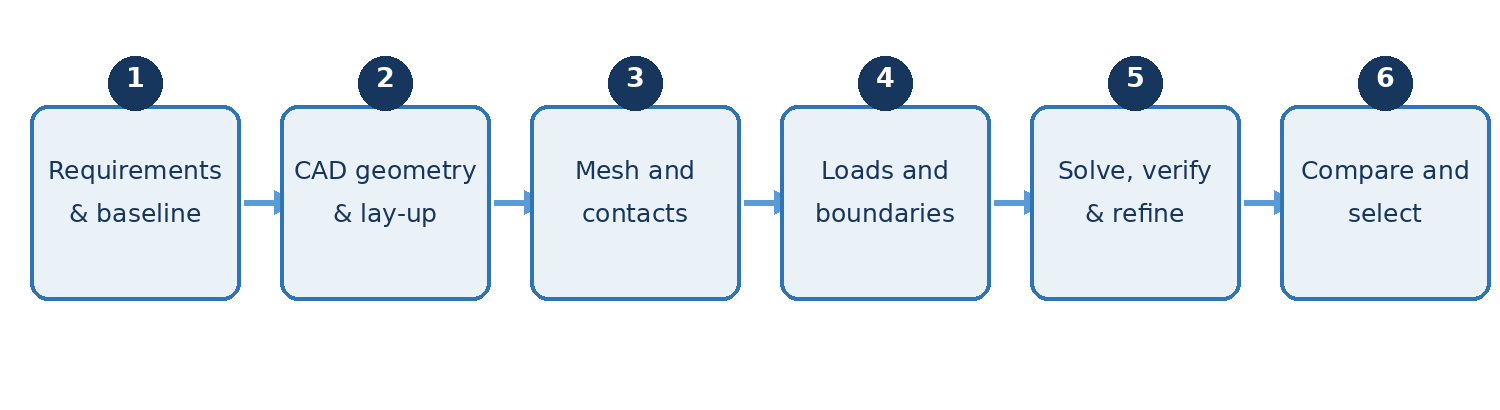
This paper presents a step-by-step finite element methodology for replacing a conventional multi-leaf steel spring with a lightweight E-glass/epoxy mono-leaf spring while preserving load capacity, vertical compliance, and structural safety. A parametric three-dimensional model is defined from a representative light-vehicle rear spring. The steel baseline is evaluated with isotropic elasticity, whereas the composite alternative is represented as a layered orthotropic laminate with fibres primarily aligned along the spring span. Mesh convergence, realistic eye and axle-seat constraints, contact sensitivity, and comparison with elementary beam theory are included as verification controls. The proposed outputs are displacement, spring rate, ply stresses, interlaminar shear indicators, Tsai-Wu failure index, modal frequency, and mass. An illustrative numerical case study predicts a mass reduction from 12.6 kg to 3.45 kg (72.6%), a spring-rate difference of 2.2% relative to the steel target, and a maximum composite failure index of 0.62 under the design load. These values demonstrate the decision logic of the methodology but require coupon tests, proof loading, and fatigue validation before production use. The workflow provides a reproducible basis for selecting laminate thickness and taper while preventing misleading conclusions from unconverged meshes or inappropriate isotropic material assumptions.