Experimental Investigation of Heat Transfer Enhancement in Double-Pipe Heat Exchangers
Keywords:
Abstract
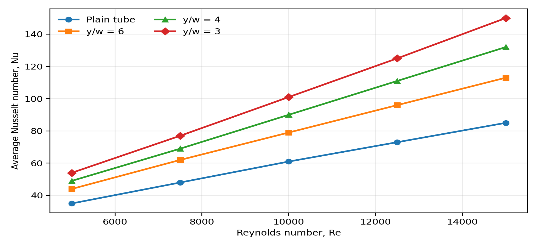
This paper presents a reproducible experimental methodology for quantifying passive heat-transfer enhancement in a concentric double-pipe heat exchanger. A water-to-water counter-flow apparatus is evaluated with a plain copper inner tube and full-length aluminium twisted-tape inserts having twist ratios (y/w) of 6, 4 and 3. The hot-side Reynolds number is varied from 5,000 to 15,000 while the annulus-side flow rate and inlet temperatures are controlled. Inlet/outlet temperatures, volume flow rates and inner-tube pressure drop are measured after steady state. Energy balance, logarithmic mean temperature difference, overall heat-transfer coefficient, Nusselt number, Darcy friction factor and a constant-pumping-power performance evaluation criterion are calculated. A calibration plan, repeat runs and uncertainty propagation are included. Representative validation data indicate that decreasing twist ratio raises Nusselt number through stronger swirl and radial mixing, but also increases friction loss. At Re = 15,000, the illustrative y/w = 3 case provides approximately 76% higher Nusselt number than the plain tube; the best thermohydraulic choice must therefore be selected using the performance criterion rather than heat transfer alone. The protocol is suitable for undergraduate and laboratory-scale research where repeatability, energy-balance closure and transparent comparison with a smooth-tube baseline are required.