CFD Analysis of Airflow Distribution in Industrial Ventilation Systems
Keywords:
Abstract
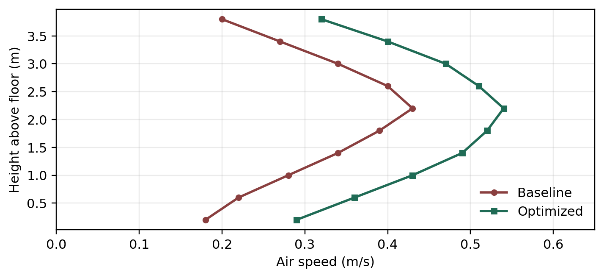
This paper presents a step-by-step computational fluid dynamics (CFD) methodology for assessing and improving airflow distribution in an industrial ventilation system. A representative manufacturing hall measuring 30 m × 18 m × 6 m is modeled with six ceiling supply diffusers, four high-level exhaust grilles, internal machinery obstructions, sensible heat loads, and a passive contaminant scalar. Steady Reynolds-averaged Navier-Stokes equations are solved with the realizable k–ε turbulence model, enhanced wall treatment, the energy equation, and species transport. Verification consists of a three-level mesh-independence study, residual and mass-balance checks, and comparison of predicted point velocities with hypothetical commissioning measurements generated for method demonstration. The baseline and optimized diffuser arrangements are compared using occupied-zone mean velocity, low-velocity volume fraction, draft-prone volume fraction, coefficient of variation, contaminant removal effectiveness, and exhaust pressure requirement. Representative results indicate that redirecting supply jets and redistributing flow rates can reduce stagnant occupied volume from 34.8% to 13.1%, lower velocity non-uniformity by 42%, and improve contaminant removal effectiveness from 0.83 to 1.08 while holding total supply flow constant. The study shows how CFD can diagnose recirculation and short-circuiting that are hidden by bulk air-change calculations. Because the numerical outcomes are illustrative rather than field observations, the paper emphasizes transparent assumptions, verification, validation planning, and reporting requirements needed before design decisions are finalized.