Design and Implementation of a Wireless Sensor Network for Environmental Monitoring Applications
DOI:
https://doi.org/10.65521/ijeecs.v9i1.4512Keywords:
Abstract
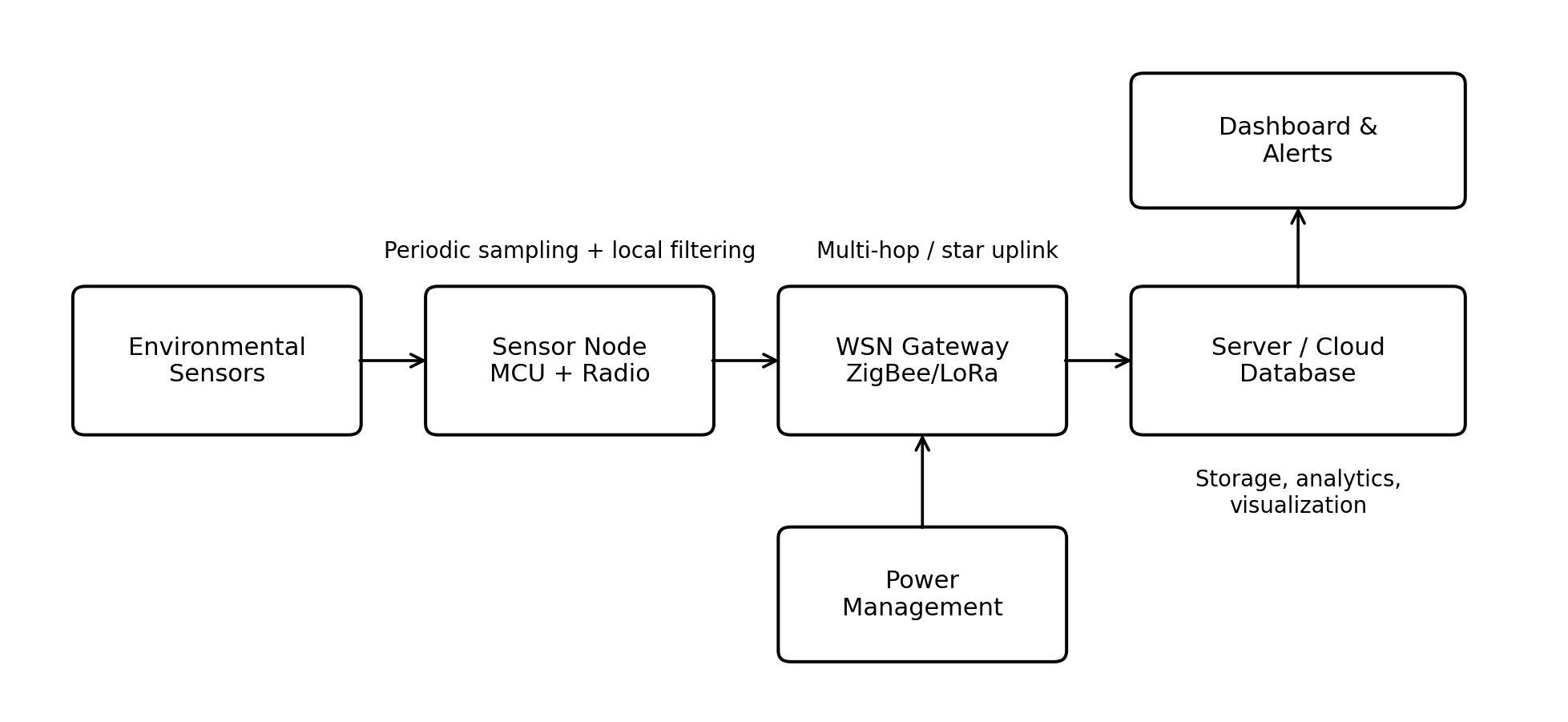
Wireless sensor networks (WSNs) provide a practical framework for distributed environmental observation because they combine low-power sensing, short-range wireless communication, local computation, and remote data access. This methodology paper presents the design and implementation workflow for a low-cost WSN intended to monitor temperature, relative humidity, light intensity, and air-quality indicators in outdoor or semi-outdoor environments. The proposed system uses battery-powered sensor nodes, periodic sampling, local validation and filtering, a gateway for data aggregation, and a server-side database for storage and visualization. The methodology emphasizes sensor calibration, energy-aware duty cycling, packet-delivery reliability, network scalability, and repeatable field testing. A prototype-oriented evaluation procedure is defined using sensing accuracy, packet delivery ratio, end-to-end latency, node energy consumption, and estimated battery life. Illustrative prototype results indicate that the architecture can maintain high packet reliability while reducing radio-on time through duty-cycled operation. The design is grounded in environmental WSN studies published up to 2020 and is intended as a reproducible framework that can be adapted to agriculture, habitat, water-quality, urban, or building monitoring applications.