Design and Implementation of an IoT-Based Smart Energy Management System
DOI:
https://doi.org/10.65521/ijeecs.v8i1.4510Keywords:
Abstract
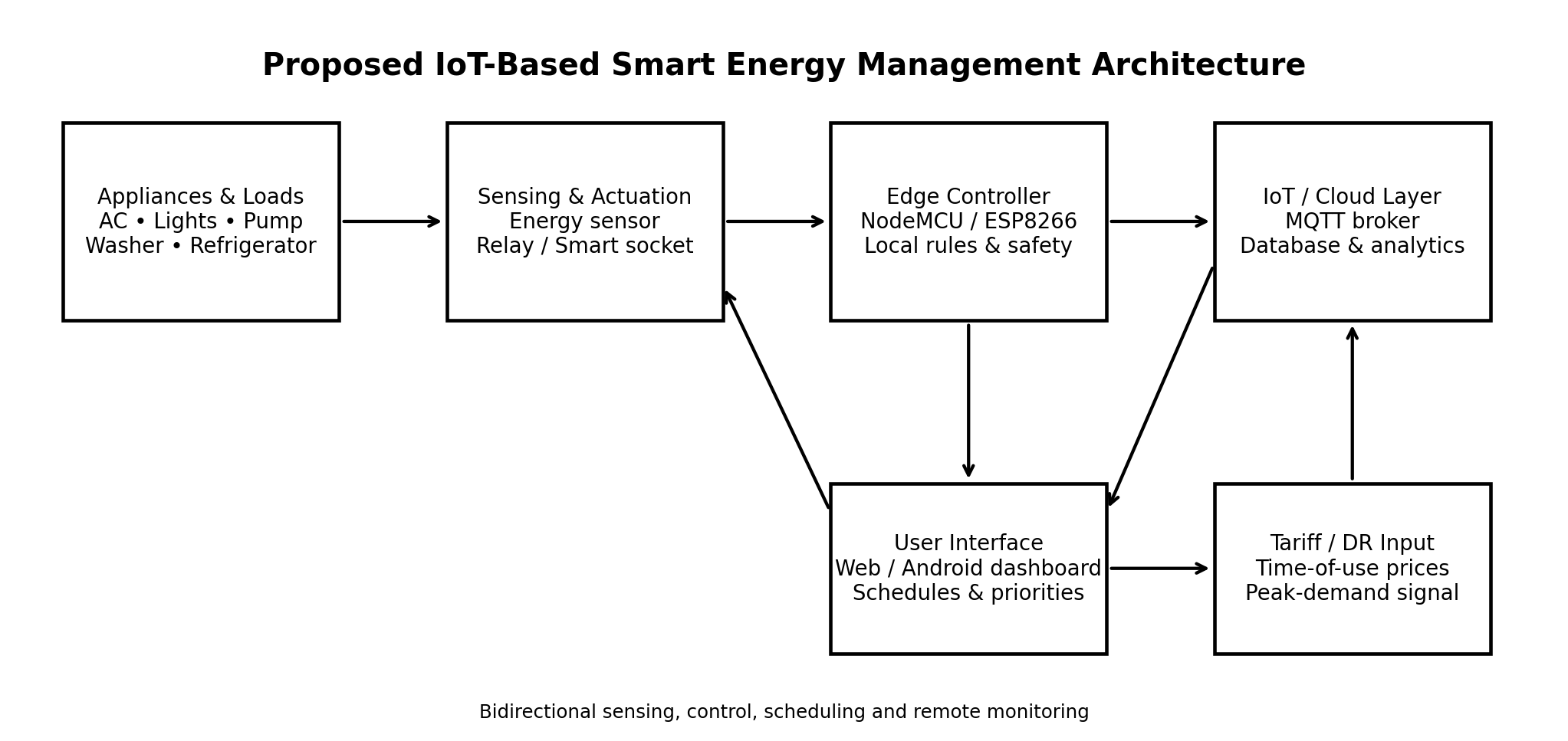
This methodology paper presents a practical framework for the design and implementation of an Internet of Things (IoT)-based Smart Energy Management System (SEMS) for residential environments. The proposed system combines appliance-level sensing, wireless connectivity, edge control, cloud-based data logging, remote visualization, and demand-response-oriented scheduling. A NodeMCU/ESP8266-class controller is used as the local gateway, while smart energy sensors and relay modules provide real-time measurement and controllable switching of household loads. The system applies a rule-based scheduling strategy that separates critical, flexible, and thermostatically controlled appliances and shifts discretionary loads away from expensive peak periods without unnecessarily compromising user comfort. A representative 24-hour evaluation scenario is included to demonstrate how the methodology can be tested when a full field trial is not yet available. In that scenario, the managed profile reduces daily energy use from 20.45 kWh to 18.36 kWh, lowers the illustrative daily electricity cost from INR 143.82 to INR 124.13, and decreases peak demand from 2.35 kW to 1.68 kW. These results are presented as reproducible methodology-validation outputs rather than claims from a completed household deployment. The architecture and evaluation procedure are informed exclusively by literature published up to 2019.