Development of a GSM-Enabled Automatic Meter Reading System
DOI:
https://doi.org/10.65521/ijeecs.v8i1.4506Keywords:
Abstract
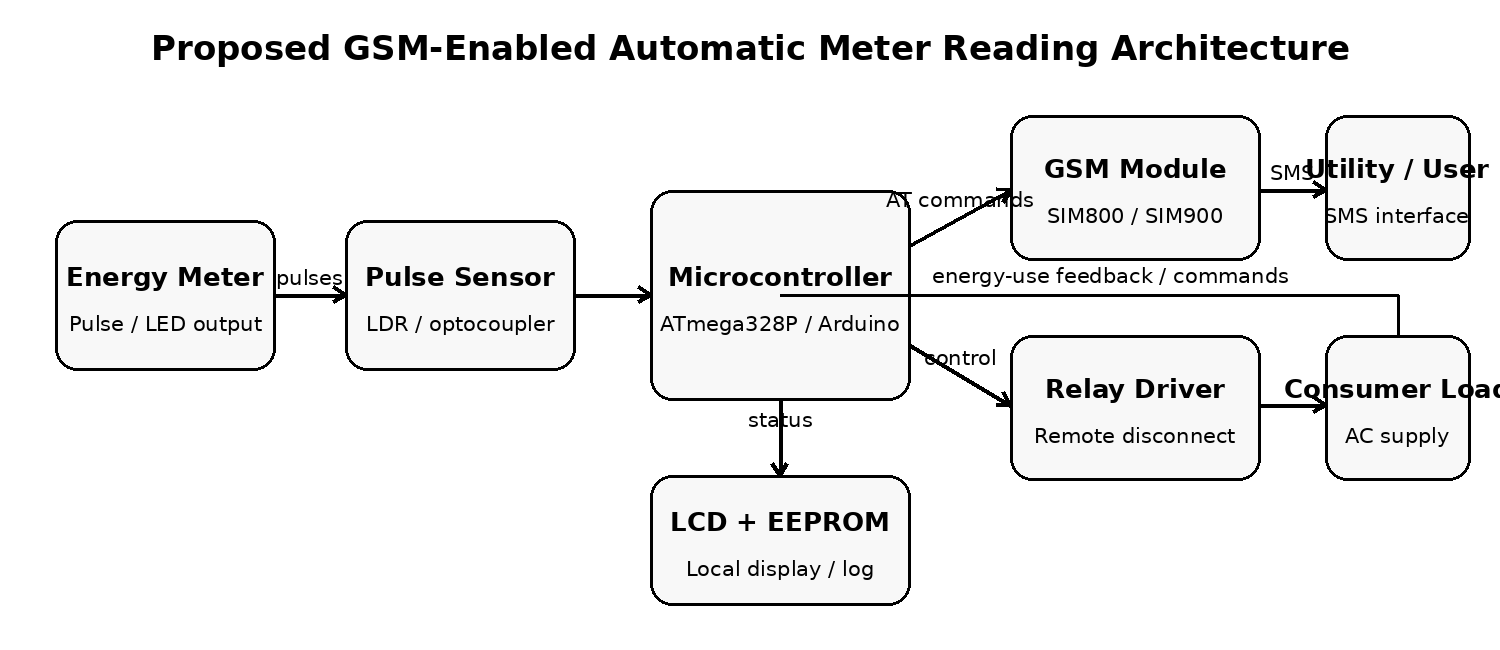
Conventional electricity-meter reading depends on periodic site visits, manual transcription, and delayed bill generation. These practices increase labour requirements, create opportunities for reading errors, and give consumers little information about current consumption. This methodology paper proposes the development of a low-cost Global System for Mobile Communications (GSM)-enabled Automatic Meter Reading (AMR) system that acquires pulse information from an electronic energy meter, converts pulses into kilowatt-hours, calculates an estimated bill, stores the latest state, and communicates usage information through Short Message Service (SMS). The proposed architecture combines an energy-meter pulse interface, an ATmega328P-class microcontroller, a GSM modem, local display and non-volatile memory, and an electromechanical relay for authenticated remote connection or disconnection. The design follows a staged procedure consisting of requirement definition, hardware integration, embedded-software development, GSM communication, billing logic, fault handling, and bench validation. Performance is assessed through metering error, message-delivery success, communication latency, command success, and recovery after power interruption. Representative methodology-validation calculations indicate that the design can target sub-1% energy-counting error under steady laboratory loads while providing practical SMS-based reporting without requiring broadband connectivity. The framework is especially appropriate where cellular coverage is more widely available than fixed Internet infrastructure. All literature used to justify the design was published no later than 2019.