Power Quality Improvement Using Unified Power Quality Conditioner in Distribution Networks
DOI:
https://doi.org/10.65521/ijeecs.v8i1.4504Keywords:
Abstract
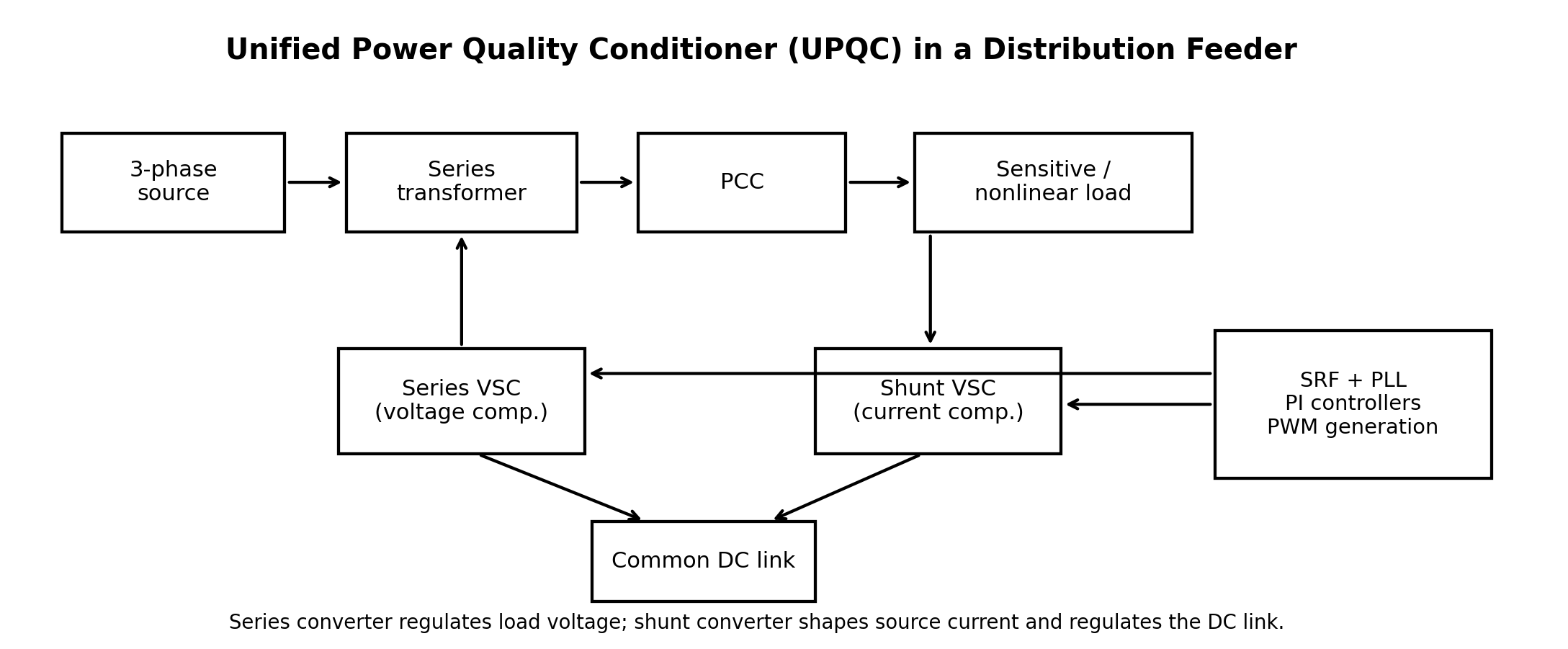
The increasing penetration of power-electronic loads, adjustable-speed drives, renewable-energy interfaces, and sensitive digital equipment has intensified voltage and current quality problems in distribution networks. This methodology paper develops a systematic approach for evaluating a Unified Power Quality Conditioner (UPQC) for simultaneous mitigation of voltage sag/swell, harmonic distortion, load unbalance, reactive-power demand, and poor power factor. The UPQC is modeled as a series voltage-source converter and a shunt voltage-source converter connected through a common DC link. Synchronous-reference-frame (SRF) theory, a phase-locked loop (PLL), proportional-integral (PI) control, and pulse-width modulation are used to generate reference signals. The evaluation uses a 400-V, 50-Hz three-phase feeder supplying nonlinear and inductive loads under four disturbance cases. Performance is quantified using RMS voltage regulation, total harmonic distortion (THD), power factor, DC-link deviation, and compensation response. The numerical study indicates that a properly coordinated UPQC can restore a 0.70 pu sag to approximately 0.986 pu, reduce source-current THD from 24.6% to 3.1%, reduce load-voltage THD from 8.1% to 1.7%, and improve source power factor from about 0.78 to 0.996. The methodology provides a reproducible basis for simulation or laboratory validation of UPQC control schemes in distribution systems and remains consistent with UPQC research published up to 2019