An Efficient Load Balancing Technique for Distributed Cloud Computing Environments
DOI:
https://doi.org/10.65521/ijeecs.v7i1.4497Keywords:
Abstract
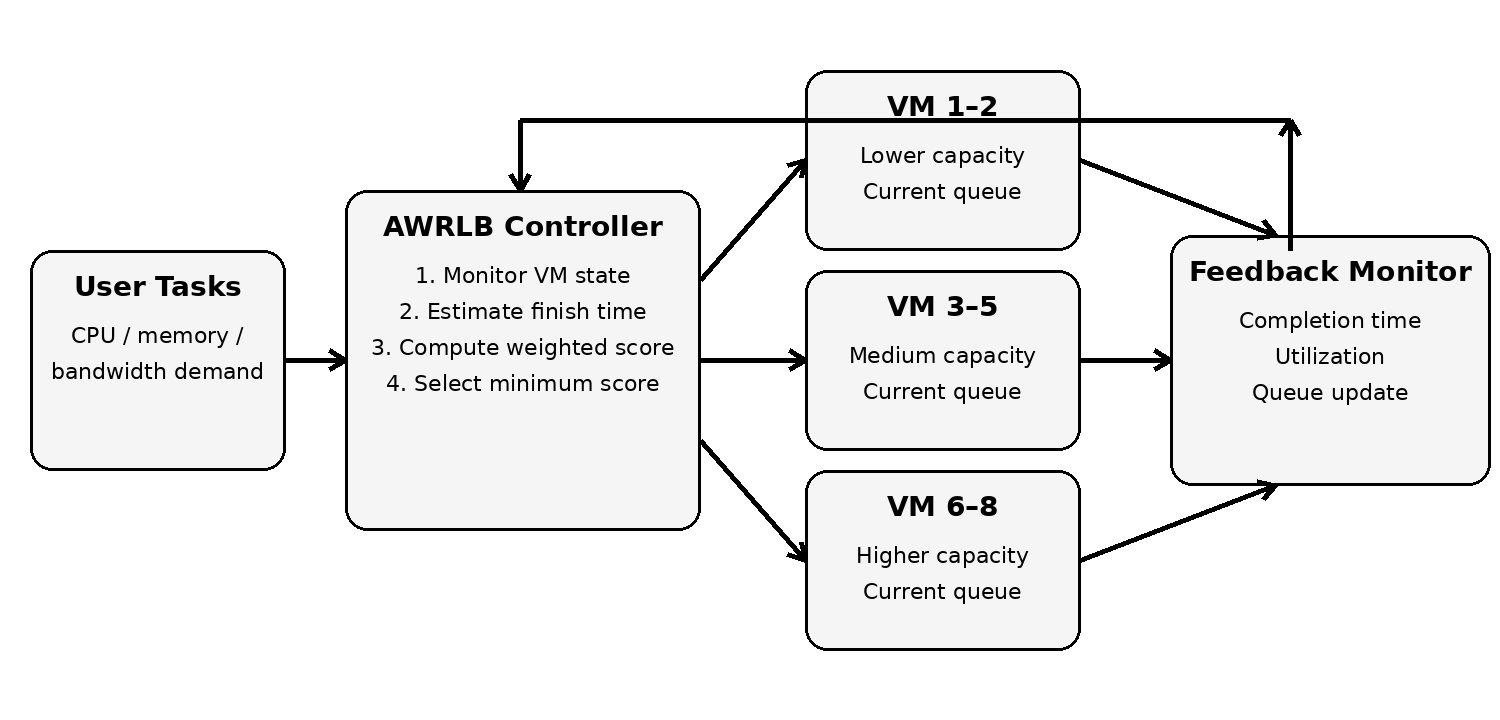
Distributed cloud computing depends on efficient assignment of dynamically arriving tasks to heterogeneous virtual machines (VMs). Static policies such as Round Robin are simple, but they do not react to queue growth, processing-speed differences, memory pressure, or network demand. This paper develops a methodology for an Adaptive Weighted Resource Load Balancing (AWRLB) technique that selects a VM using a composite score derived from projected response time, CPU demand, memory fit, and bandwidth fit. The design is motivated by cloud load-balancing literature published up to 2018, which identifies response time, makespan, throughput, resource utilization, scalability, and overload avoidance as major performance criteria. A reproducible discrete-event simulation with eight heterogeneous VMs and 1,000 dynamically arriving tasks is used to compare AWRLB with Round Robin and a simple Least-Queue policy over ten random seeds. The proposed method reduces mean response time from 24.86 s under Round Robin to 17.11 s, decreases makespan from 216.11 s to 109.51 s, and raises throughput from 4.66 to 9.13 tasks/s. The coefficient of variation of VM utilization falls from 0.366 to 0.013, indicating a substantially more even use of resources. The methodology therefore provides a practical framework for testing resource-aware scheduling before implementation in a production cloud or a full CloudSim-based environment.