Enhancement of Power Quality Using Unified Power Quality Conditioner in Distribution Networks
DOI:
https://doi.org/10.65521/ijeecs.v7i1.4495Keywords:
Abstract
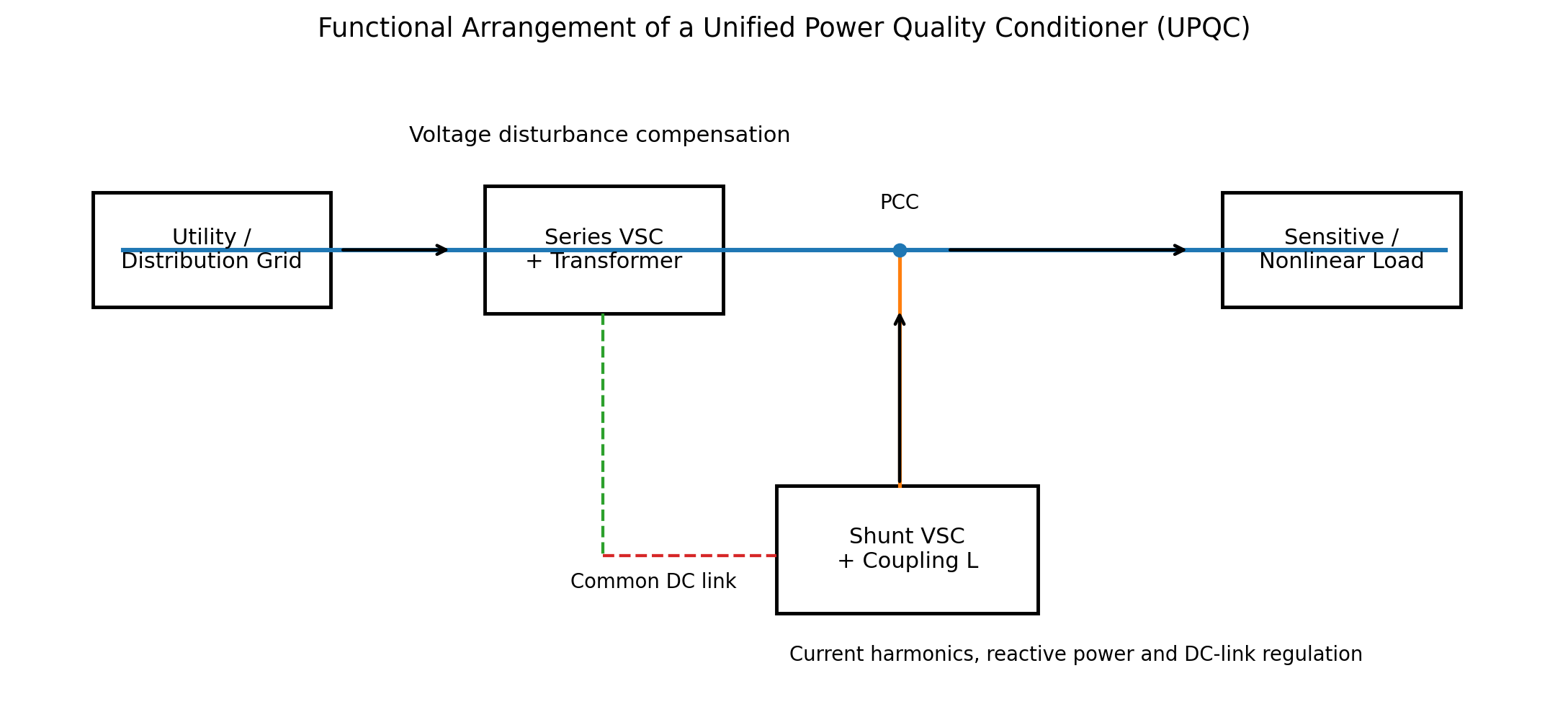
The increasing use of power-electronic loads, variable-speed drives, rectifiers, distributed generation interfaces, and sensitive digital equipment has intensified voltage- and current-related power-quality problems in distribution networks. This methodology paper develops a structured approach for evaluating a Unified Power Quality Conditioner (UPQC) as an integrated compensator for voltage sag, voltage swell, supply distortion, load-current harmonics, reactive-power demand, and poor power factor. The proposed study uses a three-phase distribution feeder with a common-DC-link series and shunt voltage-source converter. A synchronous-reference-frame control structure is adopted: the series converter regulates the load-side voltage, while the shunt converter shapes the source current, supplies compensating reactive/harmonic current, and maintains the DC-link voltage. Test cases include a 30% voltage sag, 20% swell, distorted supply, and nonlinear load. Performance is evaluated using per-unit load voltage, total harmonic distortion (THD), power factor, and DC-link stability. A representative simulation dataset shows the expected trend: load voltage remains close to 1.0 p.u. during disturbances, source-current THD can be reduced from about 18.6% to 3.1%, voltage THD from 9.4% to 2.2%, and input power factor from 0.78 to 0.99. These values are illustrative model-based results, not laboratory measurements. The methodology provides a reproducible framework for validating UPQC control in MATLAB/Simulink or an equivalent power-system simulation environment.