Recent Advances in Automatic Schizophrenia Identification Based on EEG Signals Using Dynamic Functional Connectivity Analysis and Deep Stack-Augmented Conditional Variational Autoencoder: A Systematic Review
DOI:
https://doi.org/10.65521/ijeecs.v13i1.2651Keywords:
Abstract
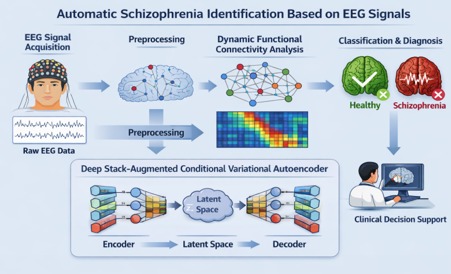
Schizophrenia is a complex neuropsychiatric disorder characterized by disruptions in perception, cognition, and emotional regulation, making early and accurate diagnosis a significant clinical challenge. Electroencephalography (EEG) has emerged as a promising non-invasive tool for identifying neural abnormalities associated with schizophrenia. In recent years, advanced computational techniques such as dynamic functional connectivity analysis and deep learning architectures have significantly enhanced automated diagnostic capabilities. This systematic review presents a comprehensive analysis of recent advancements in schizophrenia identification using EEG signals, with a particular focus on dynamic connectivity modeling and deep stack-augmented conditional variational autoencoders. The integration of temporal brain network dynamics with generative deep learning frameworks has enabled improved feature representation, robustness to noise, and better generalization across datasets. This paper critically evaluates existing methodologies, highlighting their strengths, limitations, and performance trends. Furthermore, it explores how hybrid models combining functional connectivity and probabilistic generative learning contribute to improved classification accuracy. The review also identifies key research gaps, including issues related to data heterogeneity, model interpretability, and clinical applicability. By synthesizing findings from recent studies, this work provides valuable insights into the future direction of EEG-based schizophrenia diagnosis and the role of advanced deep learning frameworks in transforming neuropsychiatric diagnostics.