Design and Performance Analysis of a Solar Powered Smart Street Lighting System
DOI:
https://doi.org/10.65521/ijeecs.v5i1.4488Keywords:
Abstract
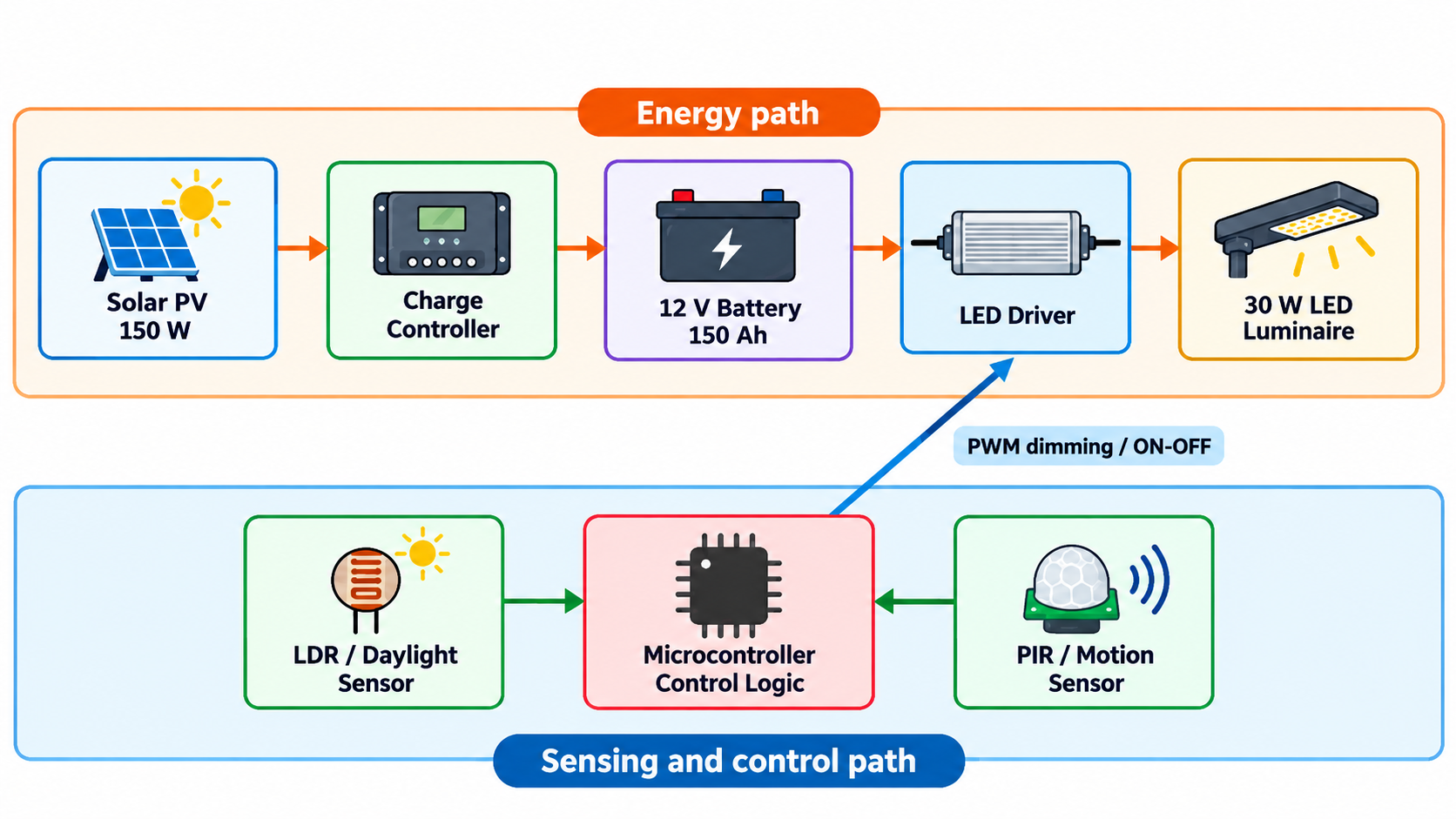
This methodology paper presents the design and analytical performance evaluation of a stand-alone solar-powered smart street lighting system intended for roads, campuses and locations where grid extension is costly or unreliable. The proposed system combines a photovoltaic (PV) module, battery storage, a charge controller, a high-efficiency LED luminaire, a microcontroller, a light-dependent resistor (LDR), and a passive infrared (PIR) motion sensor. The design objective is to maintain useful nighttime illumination while reducing energy consumption through scheduled dimming and demand-based brightness control. A step-by-step sizing procedure is developed from the nightly load profile, peak-sun-hours, component derating, allowable battery depth of discharge and required autonomy. For a representative 30 W LED lamp, the calculated smart-lighting profile requires approximately 252 Wh per night, compared with 372 Wh for an equivalent full-brightness LED system including control losses. A 150 W PV module, 12 V/150 Ah battery and 20 A controller provide a practical design margin. The calculated energy reduction is about 32%, while usable battery energy supports approximately 3.2 nights of operation without solar input. The results indicate that integrating PV generation with LED lighting and sensor-based control can substantially improve the energy efficiency and autonomy of street lighting, provided that local solar resources, battery aging, temperature and lighting standards are considered in final implementation.