Implementation of Wireless Sensor Networks for Industrial Automation Applications
DOI:
https://doi.org/10.65521/ijeecs.v5i1.4487Keywords:
Abstract
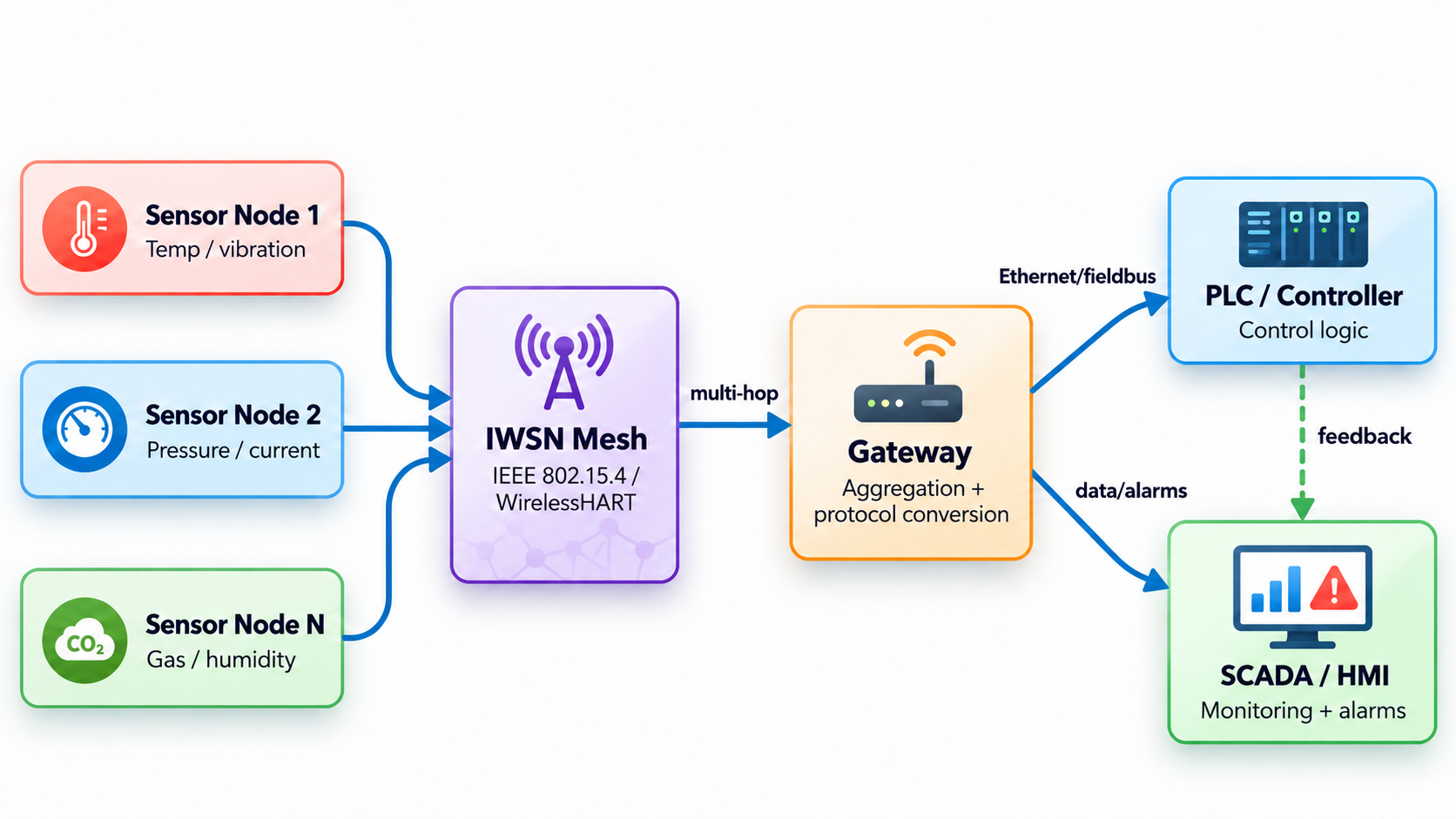
Industrial automation systems increasingly require flexible sensing, rapid deployment, continuous condition monitoring, and dependable communication in environments where extensive cabling is expensive or impractical. This methodology paper presents a structured implementation framework for an Industrial Wireless Sensor Network (IWSN) intended for monitoring and supervisory automation applications. The proposed architecture combines low-power sensor nodes, multi-hop wireless communication, an industrial gateway, and a PLC/SCADA interface. The methodology emphasizes node selection, radio planning, topology design, time-aware communication, reliability mechanisms, security, commissioning, and performance evaluation. Earlier studies established that WSNs can provide self-organization and low-cost sensing, while industrial use additionally requires predictable latency, high packet delivery, resilience to interference, and secure integration with control infrastructure (Akyildiz et al., 2002; Gungor & Hancke, 2009). The implementation therefore uses an IEEE 802.15.4-class physical layer with mesh redundancy and a WirelessHART-inspired schedule for critical traffic. A controlled evaluation scenario is defined using temperature, vibration, pressure, and current sensing nodes. Representative methodology-validation results show that redundant routing and scheduled transmissions can improve packet delivery and reduce latency variation compared with an unscheduled single-path configuration. The study concludes that IWSNs are appropriate for industrial monitoring and selected supervisory control functions when deployment is preceded by radio-site assessment and when reliability, security, and gateway integration are treated as primary engineering requirements rather than optional additions.