Comparative Study of PWM Techniques for Three-Phase Inverter Systems
DOI:
https://doi.org/10.65521/ijeecs.v5i1.4486Keywords:
Abstract
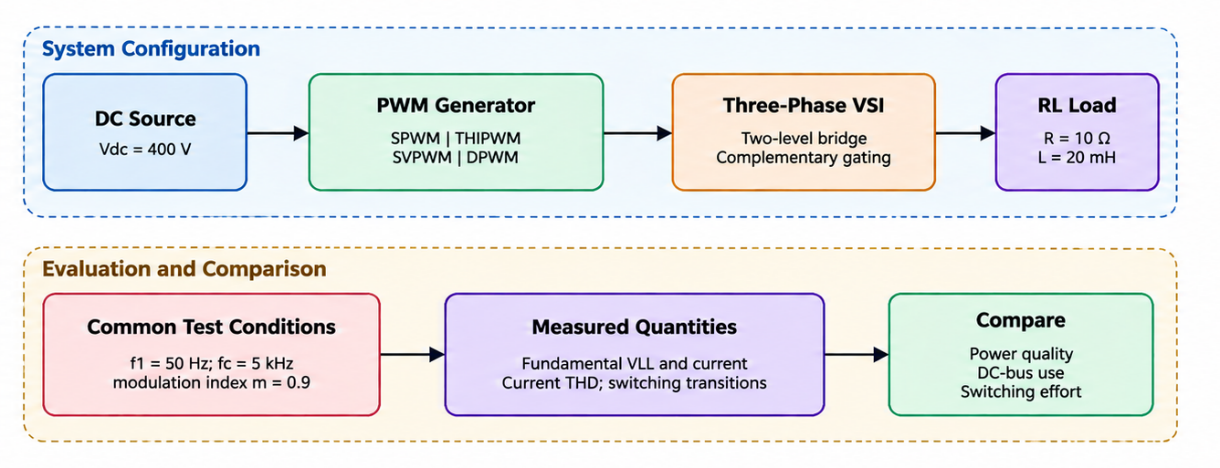
Pulse-width modulation (PWM) is the central control mechanism used to synthesize adjustable three-phase AC voltages from a fixed DC link in voltage-source inverters. The choice of PWM strategy directly affects harmonic distortion, DC-bus utilization, switching activity, acoustic behavior, and implementation complexity. This paper presents a controlled methodology for comparing four representative PWM techniques for a two-level three-phase inverter: sinusoidal PWM (SPWM), third-harmonic-injection PWM (THIPWM), carrier-equivalent space-vector PWM (SVPWM), and a discontinuous upper-clamping PWM (DPWM) variant. All methods are evaluated under identical electrical conditions: a 400 V DC link, 50 Hz fundamental frequency, 5 kHz carrier frequency, modulation index of 0.9, and a balanced 10 Ω–20 mH star-connected load. Performance indicators include line-to-line fundamental RMS voltage, phase-current fundamental RMS value, phase-current total harmonic distortion (THD), maximum linear DC-bus utilization, and switching transitions per phase leg. The numerical comparison indicates that SVPWM provides the lowest simulated current THD (0.81%) at the common operating point, THIPWM closely follows (0.84%), while SPWM gives 0.93%. The representative DPWM case reduces gate transitions from approximately 200 to 133 per phase leg per fundamental cycle, at the cost of moderately higher current THD (1.12%). The study confirms that there is no universally superior PWM method; the preferred technique depends on whether waveform quality, voltage utilization, switching loss, or algorithmic simplicity is dominant.