Development of an Embedded System for Real-Time Environmental Monitoring
DOI:
https://doi.org/10.65521/ijeecs.v5i1.4485Keywords:
Abstract
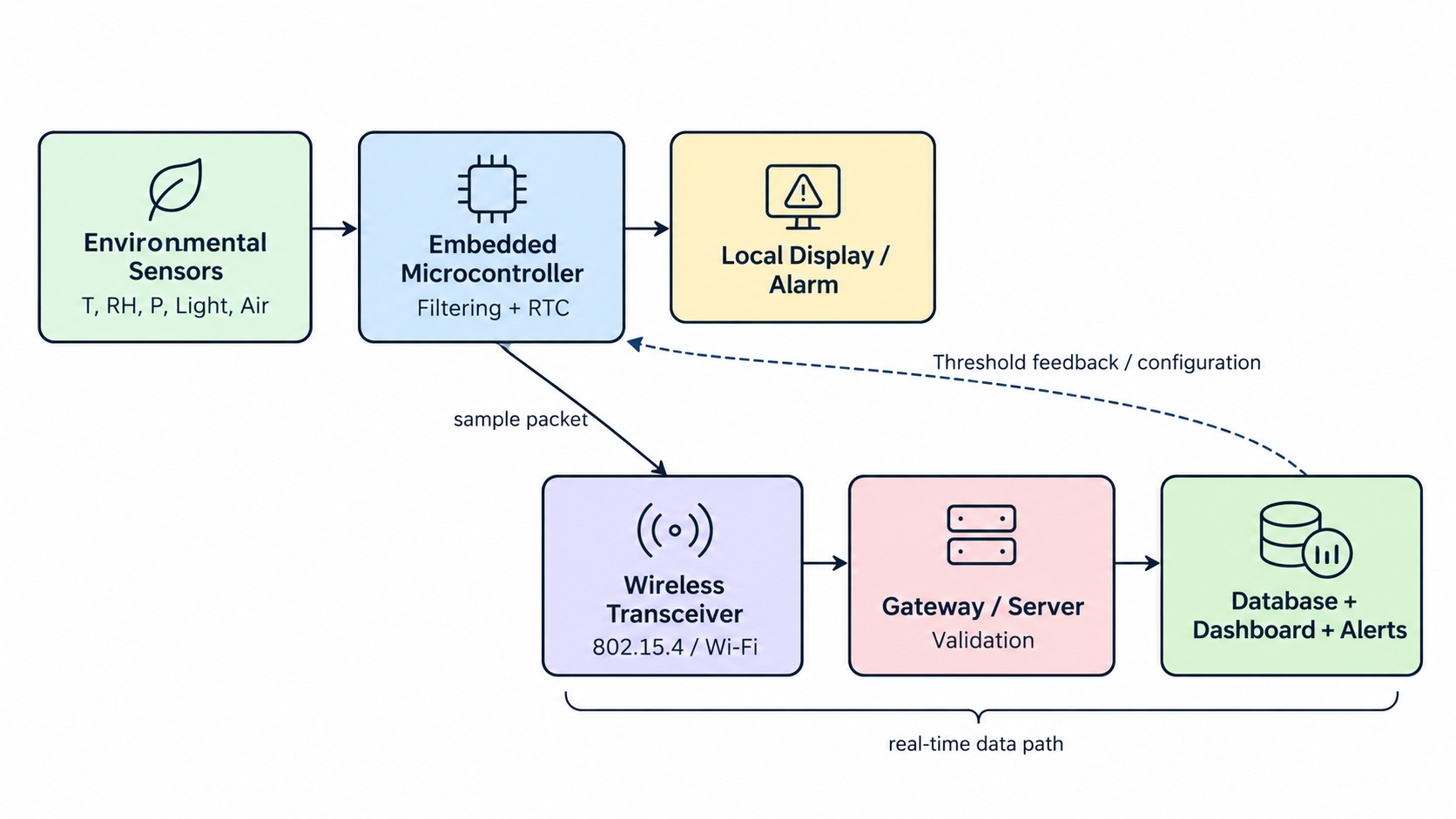
Real-time environmental monitoring requires continuous sensing, local processing, reliable communication, and rapid presentation of physical conditions. This methodology paper proposes a low-cost embedded system for monitoring temperature, relative humidity, atmospheric pressure, illumination, and a relative air-quality indicator. The design combines a microcontroller-based sensing node, local display and alarm logic, a wireless transceiver, and a gateway that records time-stamped measurements for visualization and threshold-based notification. The methodology follows a modular hardware-software architecture so that sensors or communication interfaces can be replaced without redesigning the complete system. Sensor acquisition, range checking, moving-average filtering, packet construction, transmission, storage, and alert generation are executed as a repeated real-time cycle. A controlled validation procedure is defined using reference instruments and communication tests. Illustrative prototype results show a packet-delivery ratio of 97.6%, sub-second mean end-to-end update latency, and low mean absolute deviations for temperature, humidity, and pressure. The design is intended for indoor laboratories, greenhouses, storage facilities, small industrial areas, and other locations in which continuous environmental awareness is needed. The study is grounded in embedded environmental monitoring and wireless sensor network research published no later than 2016 [1]-[11].