Embedded System Design for Home Automation and Security Applications
DOI:
https://doi.org/10.65521/ijeecs.v4i1.4468Keywords:
Abstract
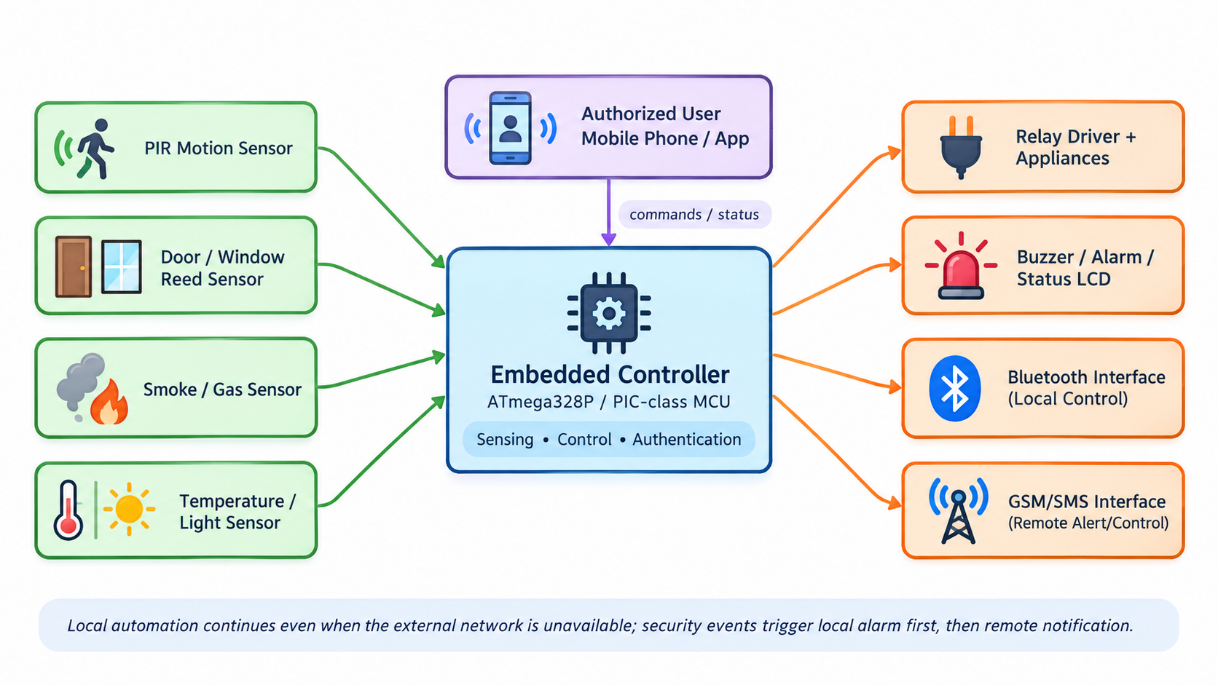
This methodology paper presents a structured design approach for an embedded home automation and security system that integrates appliance control, environmental sensing, intrusion detection, local alarms, and mobile communication. The proposed architecture centers on a low-cost microcontroller connected to passive infrared, door/window, smoke/gas, temperature, and light sensors; relay drivers are used to switch household loads, while Bluetooth supports short-range user control and GSM/SMS provides remote alerts and fallback control. The method emphasizes modular hardware, deterministic firmware, authenticated commands, event logging, fail-safe local operation, and repeatable validation. Earlier home automation studies demonstrated web-based embedded control, wireless appliance interfaces, Bluetooth control, GSM/SMS operation, ZigBee networks, and IoT monitoring, but security and interoperability remained important concerns [1]-[11]. The proposed methodology therefore combines the most practical characteristics of these approaches into a single embedded design workflow. Evaluation is defined in terms of command latency, sensing response, communication reliability, false alarm rate, load-switching accuracy, and recovery from communication failure. The paper is intended as a reproducible design-and-test framework for low-cost residential automation and security prototypes using technologies available by 2015.