Power Quality Improvement in Distribution Systems Using Active Power Filters
DOI:
https://doi.org/10.65521/ijeecs.v5i1.4484Keywords:
Abstract
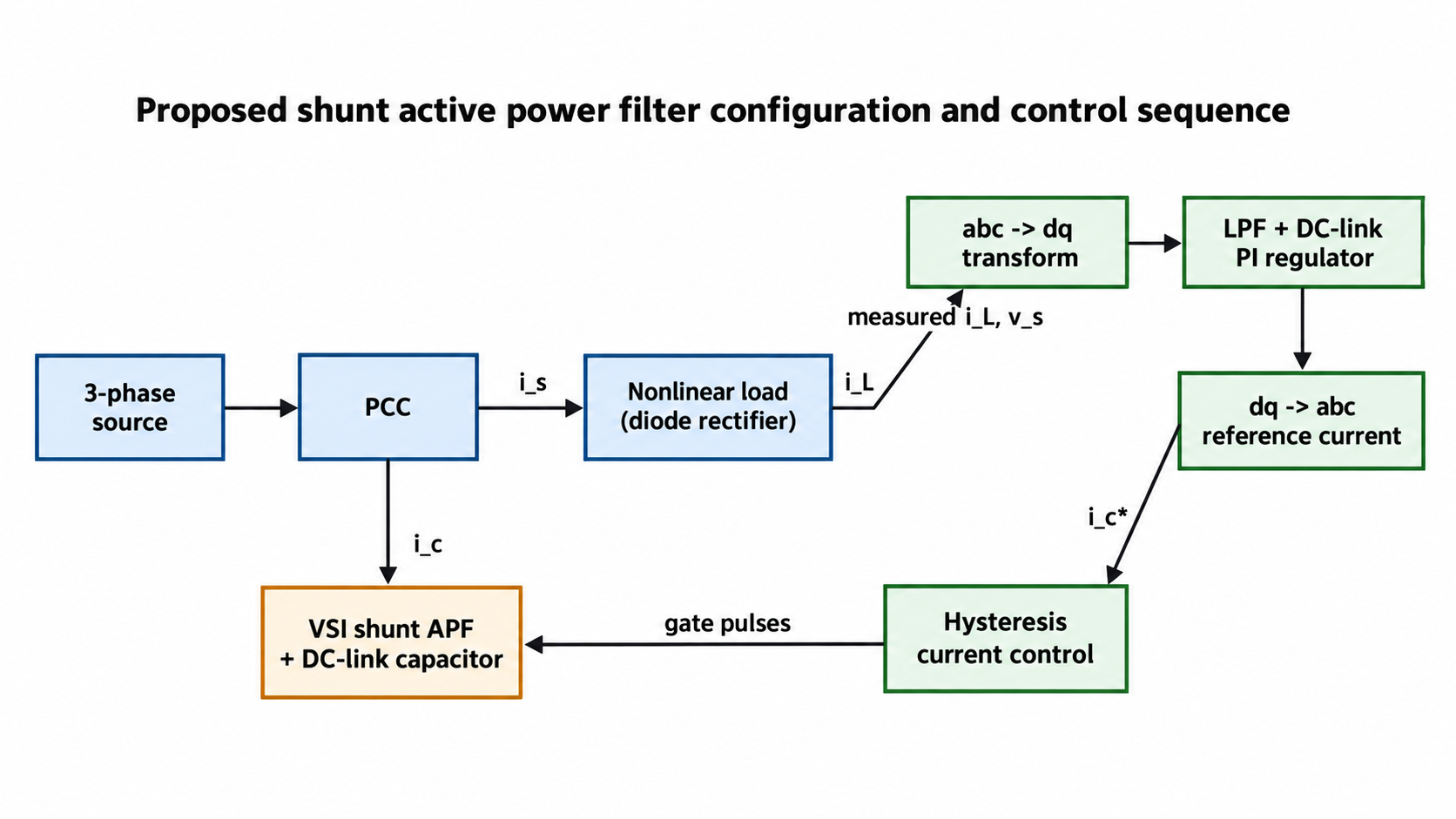
Power-electronic loads in modern distribution systems draw nonsinusoidal and reactive currents, producing current harmonics, reduced power factor, additional feeder losses and voltage distortion at the point of common coupling (PCC). This methodology paper develops a simulation-oriented procedure for evaluating a three-phase shunt active power filter (SAPF) as a distribution-level power-quality compensator. The proposed filter uses a voltage-source inverter, dc-link capacitor, coupling inductors, synchronous reference frame (d-q) current extraction, a proportional-integral dc-link regulator and hysteresis current control. A nonlinear diode-rectifier load is represented by a fundamental current together with dominant 5th, 7th, 11th and 13th harmonics. Performance is evaluated through source-current total harmonic distortion (THD), true power factor, harmonic-current RMS value, dc-link regulation and transient settling. The modeled baseline produces 26.9% load-current THD and a true power factor of approximately 0.79. With compensating currents injected by the SAPF, the source-current THD falls to 3.4% and the power factor rises to approximately 0.99. Additional load-step and distorted-source cases remain below 5% THD. The method therefore demonstrates how a properly controlled SAPF can provide adaptive harmonic suppression and reactive-power compensation without the resonance and fixed tuning limitations associated with passive filters. The study is grounded only in literature published through 2016.