Performance Analysis of Grid-Connected Solar Photovoltaic Power Generation Systems
DOI:
https://doi.org/10.65521/ijeecs.v4i1.4480Keywords:
Abstract
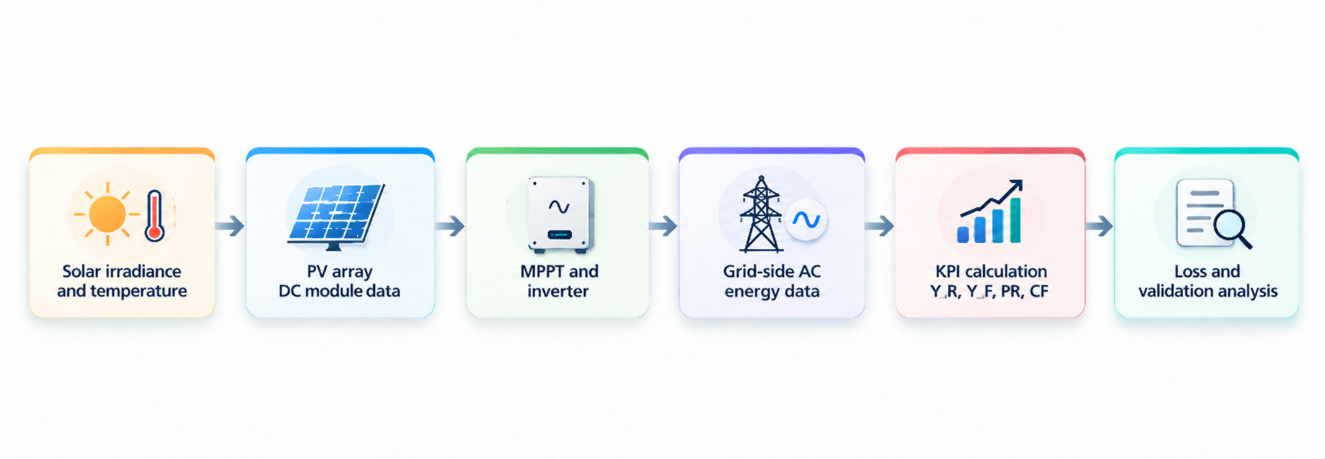
Grid-connected solar photovoltaic (PV) power plants are increasingly evaluated using normalized performance indicators that separate the effect of solar resource from losses caused by temperature, conversion, wiring, soiling, mismatch, and grid unavailability. This methodology paper develops a reproducible framework for analysing the performance of a grid-connected PV power generation system using monitored or simulation-based data. The framework combines plane-of-array irradiance, module temperature, DC power, AC energy, inverter operation, and grid availability with reference yield, final yield, performance ratio, capacity factor, specific energy yield, and inverter efficiency. A single-diode PV representation is used when direct field measurements are incomplete, while the results are benchmarked against established grid-connected PV studies published no later than 2015. To demonstrate the procedure without claiming new field measurements, an illustrative 1 MWp reference plant is evaluated using a one-year benchmark dataset representative of high-solar-resource conditions. The demonstration gives annual plane-of-array irradiation of 1910 kWh/m2, final yield of 1486.9 kWh/kWp, performance ratio of 77.85%, and capacity factor of 16.97%. The values fall within the range reported by earlier long-term and Indian grid-connected PV studies. The proposed method is suitable for academic studies, plant diagnostics, comparative assessment, and preliminary design validation, provided that future empirical applications replace the illustrative inputs with site-specific measurements and document sensor quality, missing-data treatment, and uncertainty.