Elevate: An AI-Powered Health & Performance Platform
DOI:
https://doi.org/10.65521/ijeecs.v15i1S.2960Keywords:
Abstract
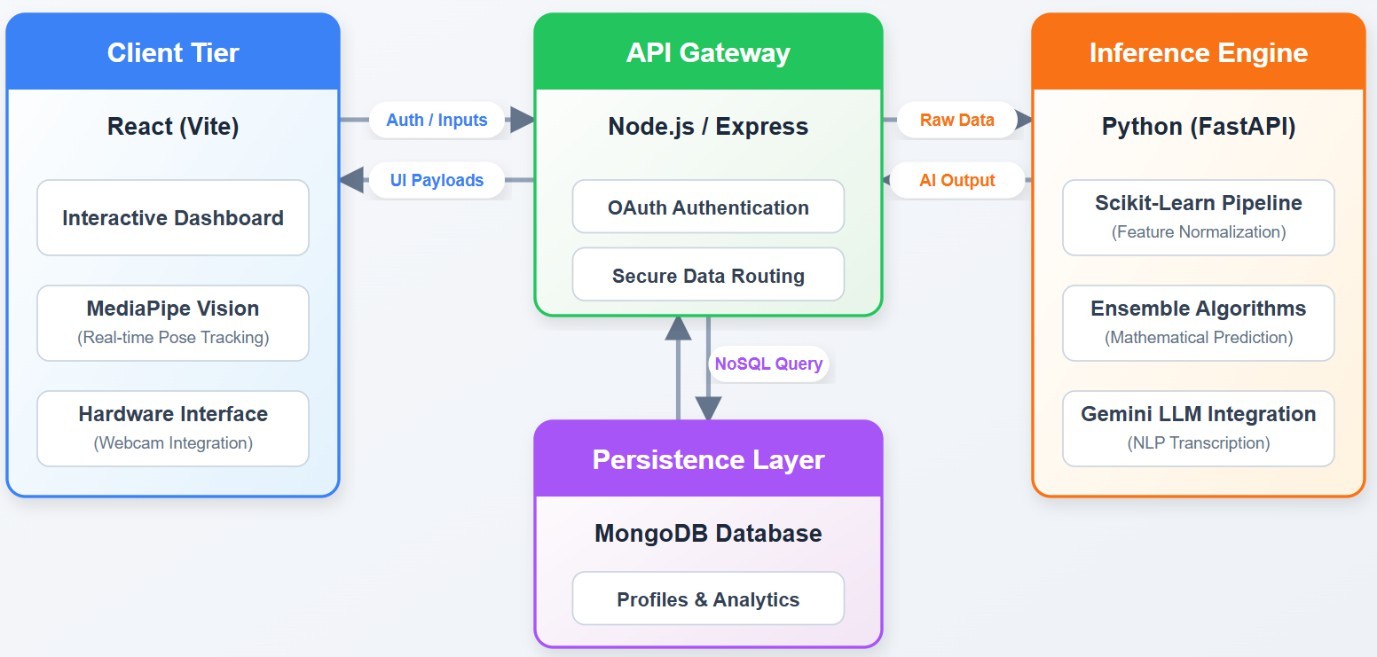
The growing demand for personalized health and wellness solutions has highlighted the limitations of traditional rule-based fitness systems. This study presents the design and evaluation of Elevate, an intelligent fitness platform that integrates machine learning and computer vision to generate personalized workout and nutrition recommendations. The system is implemented using a microservices architecture comprising a React-based frontend, a Node.js backend for authentication and data management via MongoDB, and a Python FastAPI-based inference engine. The predictive component employs an XGBoost MultiOutputRegressor to estimate multiple fitness parameters, including sets, repetitions, rest intervals, and nutritional requirements, based on user-specific physiological data. Additionally, real-time human pose estimation is achieved using Google MediaPipe to support exercise form monitoring, while a large language model is utilized to convert structured outputs into user- friendly feedback. The system also incorporates rule-based validation mechanisms to constrain model outputs within predefined safety limits. The results indicate that integrating machine learning, computer vision, and rule-based validation within a modular architecture can support the development of adaptive and reliable personalized fitness applications.