Subway Flood Monitoring and Different Vehicle Allowance
DOI:
https://doi.org/10.65521/ijeecs.v15i1S.2950Keywords:
Abstract
Urban flooding in subway systems has become a major safety and transportation challenge in modern cities, particularly during periods of heavy rainfall and inadequate drainage conditions. Subways and underpasses are generally constructed below ground level, making them highly vulnerable to rapid water accumulation during storms and monsoon seasons. Waterlogging in such areas can lead to severe traffic congestion, vehicle breakdowns, infrastructure damage, economic losses, and life-threatening situations for commuters. In many cases, drivers unknowingly enter flooded subways, resulting in engine failure, vehicle stalling, and accidents that may cause injuries or fatalities. Therefore, there is a growing need for intelligent and automated flood monitoring systems capable of providing real-time information and controlling vehicle movement in flood-prone subway regions.
This research focuses on the design and development of a Subway Flood Monitoring System integrated with a Vehicle Allowance Mechanism to improve urban transportation safety and traffic management during flood conditions. The primary objective of the proposed system is to continuously monitor water levels in subway areas and automatically regulate vehicle entry based on real-time flood conditions. By integrating sensor-based water level detection with automated signaling mechanisms, the system aims to prevent vehicles from entering dangerous flooded zones and reduce the risk of accidents, property damage, and human casualties.
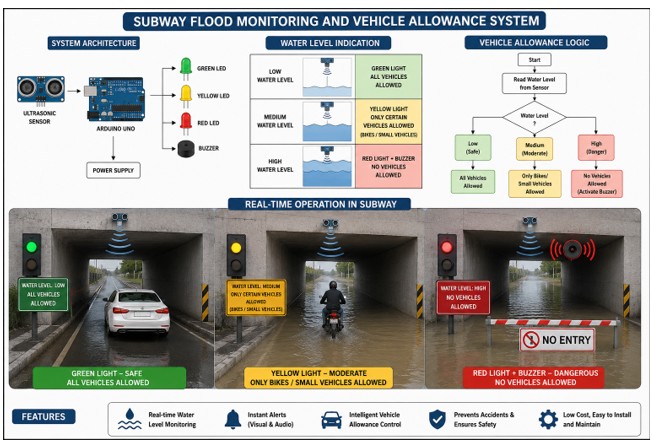
The proposed methodology utilizes ultrasonic sensors, Arduino-based microcontrollers, LED indicators, and buzzer alarm systems for automated monitoring and warning operations. Ultrasonic sensors are used to continuously measure the distance between the sensor and the water surface. As the water level rises, the measured distance decreases, and this information is transmitted to the Arduino microcontroller for processing. The controller compares the measured water level with predefined threshold values and activates corresponding indicators and warning mechanisms.
Different LED indicators are used to represent varying flood conditions. A GREEN indicator represents a safe condition where all vehicles are allowed to pass through the subway. A YELLOW indicator signifies moderate water levels where only certain vehicles, such as bikes or small vehicles, may be allowed. A RED indicator along with a buzzer alarm is activated when the water level becomes dangerous, completely restricting vehicle entry to prevent accidents and vehicle damage. This intelligent vehicle allowance mechanism improves traffic regulation by ensuring that vehicles are permitted only under safe conditions.