Recent Advances in Optimizing Electric Vehicle Charging with Parallel Convolutional Neural Network: Coordinating Smart Grids and Intelligent Transportation Systems: A Systematic Review
DOI:
https://doi.org/10.65521/ijeecs.v14i2.2888Keywords:
Abstract
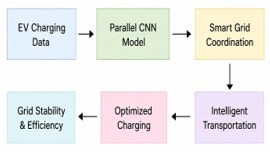
The rapid expansion of electric vehicles (EVs) has created significant challenges in managing charging demand and maintaining power grid stability. The integration of IoT-enabled smart grids and intelligent transportation systems has emerged as a promising solution for coordinating EV charging and energy distribution. However, the dynamic nature of EV charging behaviour, coupled with traffic variability and renewable energy integration, requires advanced computational approaches for efficient management. Deep learning techniques, particularly Convolutional Neural Networks (CNNs), have demonstrated strong capabilities in analysing complex energy and transportation datasets. Parallel CNN architectures enhance this capability by simultaneously processing multiple data streams, such as traffic flow, charging demand, and grid conditions, thereby improving prediction accuracy and decision-making efficiency. Recent studies highlight that hybrid CNN-based models significantly outperform traditional forecasting techniques in EV load prediction and scheduling. Optimization techniques such as reinforcement learning and multi-objective optimization have been widely applied to coordinate EV charging with grid operations. These methods enable dynamic scheduling and load balancing, reducing peak demand and improving energy efficiency. Additionally, vehicle-to-grid (V2G) systems allow bidirectional energy flow, enhancing grid stability and reducing operational costs. This review focuses on advancements in recent years, highlighting key methodologies, architectures, and challenges. Despite progress, issues such as scalability, computational complexity, and real-time deployment remain critical. The integration of deep learning, IoT, and optimization frameworks is expected to play a crucial role in future intelligent energy and transportation systems.