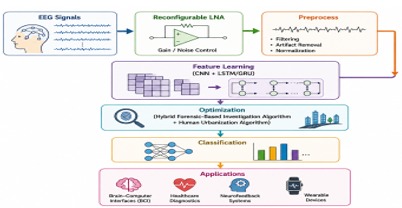
Deep Learning and Optimization Approaches in Design of Reconfigurable Low Noise Amplifier using Hybrid Forensic-Based Investigation Algorithm and Human Urbanization Algorithm for EEG classification: A Review
DOI:
https://doi.org/10.65521/ijeecs.v12i2.2639Keywords:
Abstract
The rapid advancement of biomedical signal processing and artificial intelligence has significantly enhanced the efficiency of EEG-based classification systems. Electroencephalogram (EEG) signals are highly sensitive, low-amplitude signals that require precise amplification and noise reduction for accurate analysis. This paper presents a comprehensive review of deep learning and optimization approaches in the design of reconfigurable low-noise amplifiers (LNAs) integrated with hybrid forensic-based investigation algorithms and human urbanization algorithms for EEG classification. Reconfigurable LNAs play a crucial role in improving signal-to-noise ratio (SNR) and enabling adaptive gain control for varying signal conditions in wearable and real-time systems. Deep learning techniques, particularly convolutional neural networks (CNNs) and hybrid models such as CNN-LSTM and CNN-GRU, have demonstrated superior performance in extracting spatial and temporal features from EEG signals. Furthermore, hybrid optimization algorithms enhance feature selection and classification accuracy while reducing computational complexity. The integration of hardware-efficient LNA design with intelligent deep learning frameworks leads to improved system performance, reduced power consumption, and enhanced reliability. This review highlights the importance of hardware–software co-design in developing next-generation EEG classification systems and discusses future research directions for adaptive, low-power, and high-accuracy biomedical devices.