Design and Performance Analysis of Energy-Efficient Routing Protocols for Wireless Sensor Networks
DOI:
https://doi.org/10.65521/ijaece.v10i1.4474Keywords:
Abstract
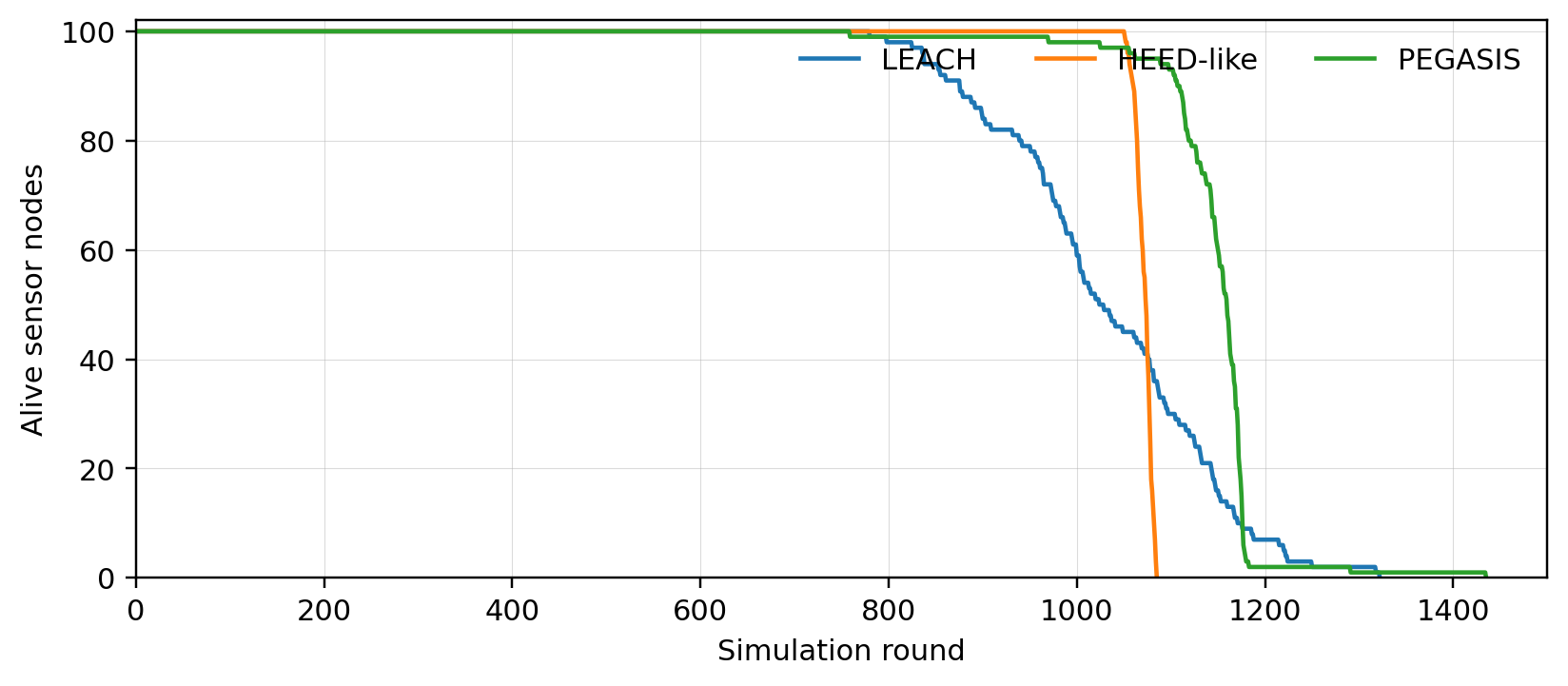
Wireless sensor networks (WSNs) consist of battery-powered sensing devices whose lifetime is strongly influenced by the energy spent on wireless communication. This methodology paper presents a reproducible framework for the design and performance analysis of energy-efficient routing protocols, emphasizing three representative paradigms: LEACH (cluster-based), HEED (energy-aware distributed clustering), and PEGASIS (chain-based data gathering). The evaluation uses a first-order radio-energy model, random deployment of 100 homogeneous sensor nodes, a fixed base station outside the sensing field, periodic data generation, and common energy parameters for fair comparison. Performance is assessed through first-node-death (FND), half-node-death (HND), last-node-death (LND), residual network energy, and routing behavior. The representative simulation indicates that HEED-like residual-energy selection extends the stable period before the first node fails, while PEGASIS retains more total energy at later rounds and achieves the longest overall lifetime. LEACH remains attractive because of its simplicity and distributed operation but experiences earlier energy imbalance under the selected topology. The study shows that routing efficiency cannot be judged by a single metric; stability, total lifetime, communication distance, aggregation overhead, and scalability must be evaluated together. The proposed methodology can be reused to compare additional routing protocols under identical assumptions and supports systematic protocol selection for monitoring-oriented WSN applications.