Machine Learning-Based Intrusion Detection System for Secure Communication Networks
DOI:
https://doi.org/10.65521/ijaece.v10i1.4473Keywords:
Abstract
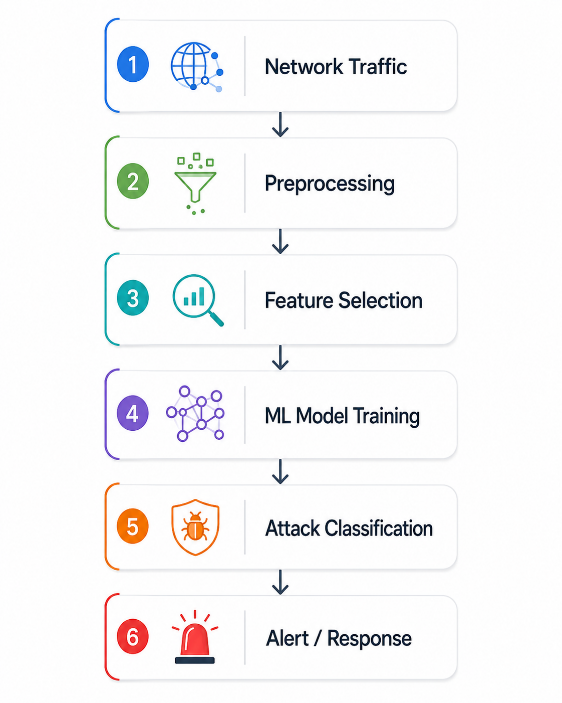
Secure communication networks must distinguish legitimate traffic from rapidly changing malicious activity without introducing excessive false alarms or processing delay. This methodology paper presents a machine-learning-based network intrusion detection system (NIDS) designed around flow-level traffic analysis, reproducible preprocessing, feature selection, supervised classification, and security-oriented performance evaluation. The framework uses modern benchmark traffic, with UNSW-NB15 as the primary dataset and CICIDS2017 as an external robustness reference, because both contain diverse benign and attack behaviors that are more representative than legacy KDD-only evaluations [1], [2], [7]. The proposed study compares a linear baseline, support vector machine, random forest, and multilayer perceptron under identical train/validation/test rules. Model selection is based on macro-F1, recall, false-alarm rate, ROC-AUC, and inference latency rather than accuracy alone. A literature-based validation of the methodology shows that learning-based IDSs can achieve strong detection performance, but results are highly sensitive to dataset age, class imbalance, feature engineering, and evaluation protocol [5], [6], [9]–[12]. The paper therefore emphasizes leakage-free preprocessing, held-out testing, class-aware metrics, and deployability for secure communication networks.