Performance Analysis of IoT-Based Smart Grid Monitoring and Control Systems
DOI:
https://doi.org/10.65521/ijaece.v9i1.4467Keywords:
Abstract
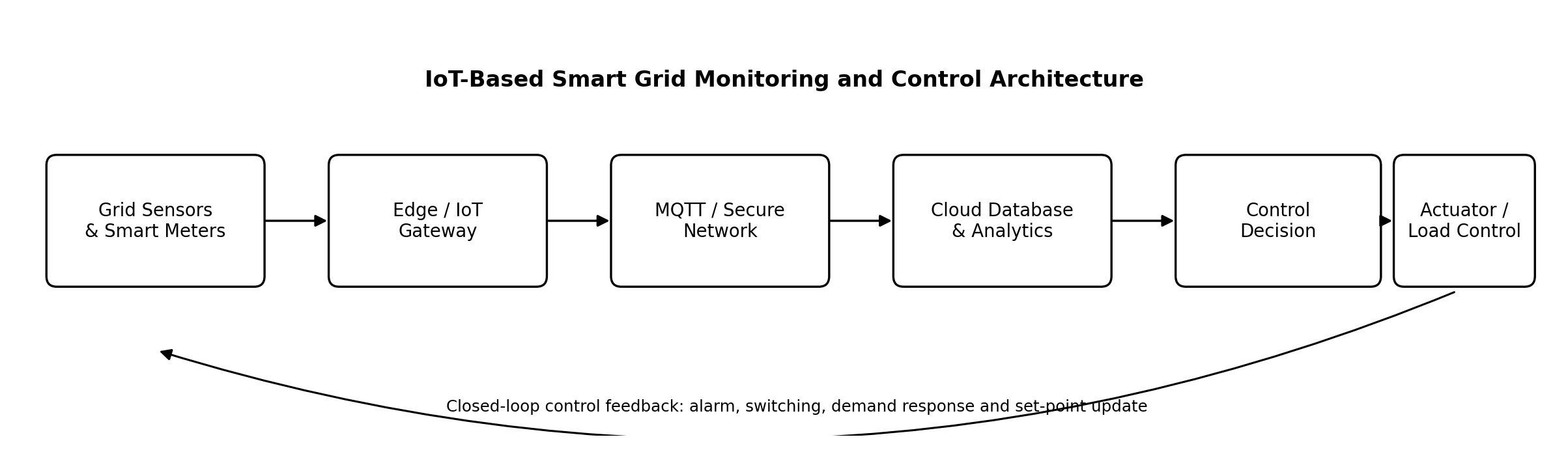
The integration of Internet of Things (IoT) technologies with smart grids enables continuous sensing, two-way communication, remote supervision, and automated control of electrical infrastructure. This methodology paper develops and evaluates a compact IoT-based monitoring and control framework for smart-grid applications, with particular emphasis on communication performance, measurement availability, and closed-loop response. The proposed architecture combines smart meters and electrical sensors, an edge gateway, an MQTT-based communication layer, cloud-side storage and analytics, and actuator commands for demand response or protective switching. A controlled emulation is defined to compare the proposed event-aware IoT scheme with a conventional periodic cloud-polling scheme under 250-, 500-, and 1,000-node workloads. Performance is assessed using end-to-end latency, packet delivery ratio, control-response time, and normalized communication traffic. The emulated results indicate that the event-aware architecture reduces average message latency by approximately 59–63%, improves packet delivery by 2–6 percentage points under increasing load, and shortens control response by more than half. These findings support the use of lightweight messaging, edge filtering, and closed-loop control for scalable smart-grid monitoring, while also emphasizing security, interoperability, and field validation as essential deployment requirements.