Development of Wireless Sensor Network-Based Environmental Monitoring Systems for Smart Applications
DOI:
https://doi.org/10.65521/ijaece.v9i1.4464Keywords:
Abstract
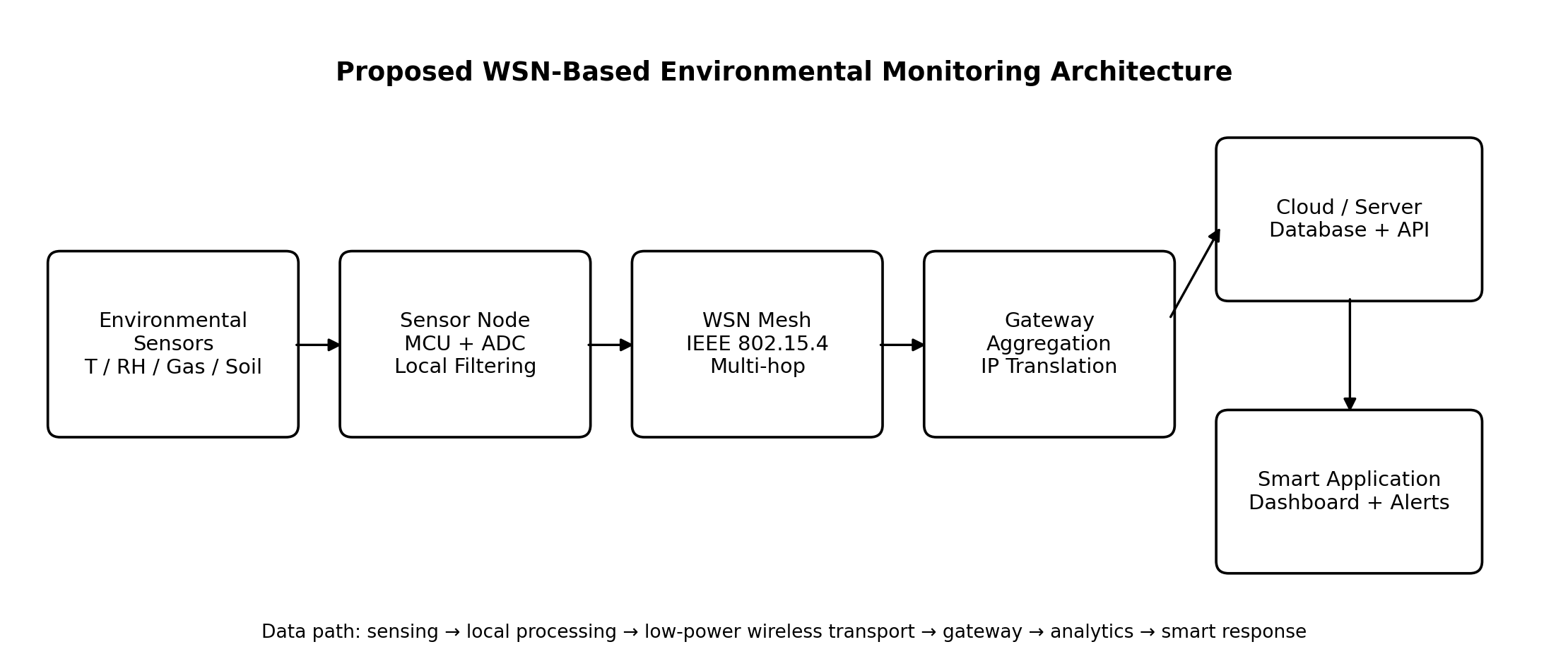
Wireless sensor networks (WSNs) provide a practical foundation for continuous environmental monitoring because distributed sensing, low-power communication, local processing, and Internet connectivity can be combined in a compact architecture. This methodology paper develops a WSN-based framework for smart environmental applications that monitor temperature, relative humidity, air-quality indicators, light intensity, and soil moisture and then transfer the observations to an Internet-connected gateway for storage, visualization, threshold detection, and alerts. The proposed methodology follows five stages: requirement definition, sensing-node design, network and gateway configuration, data-management and smart-application integration, and prototype-level performance evaluation. The design adopts low-duty-cycle sensing, local validation and filtering, multi-hop IEEE 802.15.4-class communication, gateway aggregation, and a cloud/database layer. Performance is assessed through packet delivery ratio, end-to-end latency, sensing completeness, energy duty cycle, and alert responsiveness. An illustrative controlled evaluation demonstrates how the framework can maintain high data availability while reducing unnecessary radio activity through sleep scheduling and local filtering. The study synthesizes lessons from WSN, environmental monitoring, energy-efficiency, and Internet of Things literature published up to 2020. The resulting architecture is modular and can be adapted to smart agriculture, urban microclimate monitoring, greenhouse control, pollution surveillance, and habitat observation, while acknowledging that real field deployments require site-specific calibration, radio-link characterization, weatherproofing, security, and long-duration energy validation.