Design and Performance Analysis of IoT-Based Smart Home Automation Systems
DOI:
https://doi.org/10.65521/ijaece.v8i1.4462Keywords:
Abstract
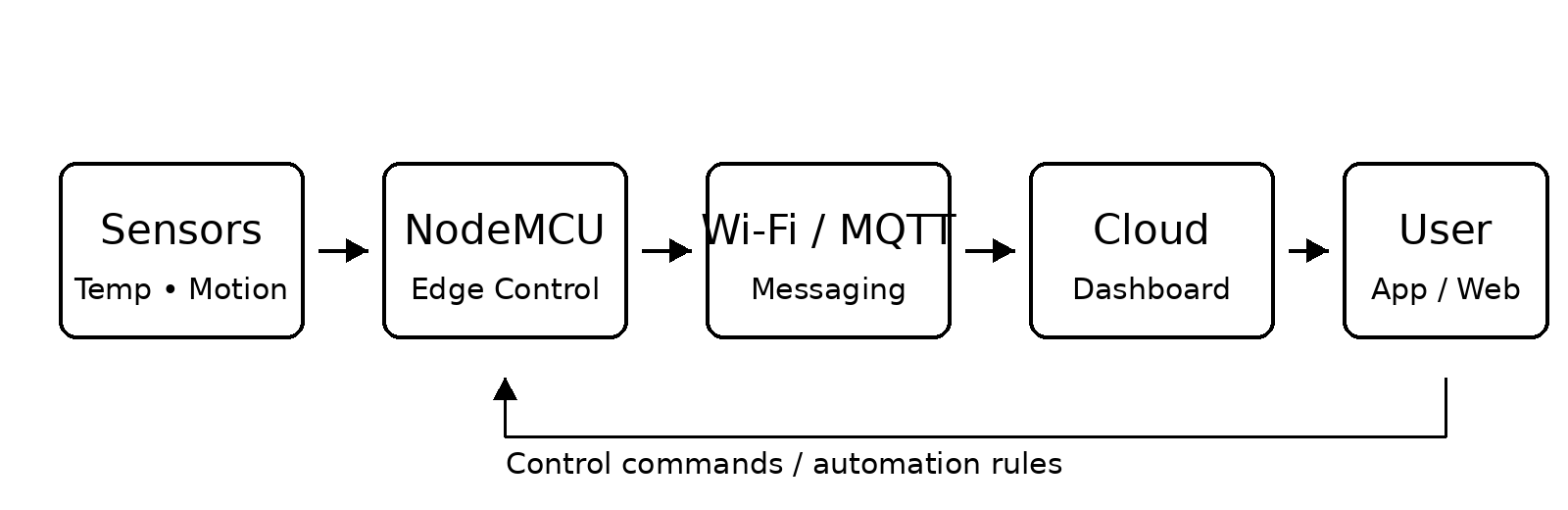
The Internet of Things (IoT) has transformed home automation from isolated electronic control into a connected environment in which sensors, controllers, cloud services, and user interfaces cooperate in real time. This methodology paper presents the design and performance analysis of a low-cost IoT-based smart home automation architecture intended for appliance control, environmental monitoring, security notification, and basic energy management. The proposed design uses sensor nodes connected to a NodeMCU-class controller, Wi-Fi connectivity, MQTT-style publish/subscribe messaging, relay-based actuation, and a mobile/web dashboard. The methodology combines architectural design with a simulation-based performance evaluation so that latency, command success rate, packet loss, and household energy use can be examined without claiming an unperformed physical experiment. Four communication conditions are modeled over 300 control transactions per condition, while a 24-hour appliance-load model is used to estimate the effect of occupancy-aware automation. The generated results indicate that local and sensor-triggered control can provide sub-0.2 s average responses, whereas cloud and congested links introduce higher delay. The energy model produces an estimated reduction of about 14% compared with a non-automated operating schedule. The study concludes that a gateway-centered IoT architecture can provide responsive and energy-aware home automation, while security, interoperability, and network dependence remain important design constraints.