Development of GSM-Based Home Security and Monitoring Systems for Remote Applications: Performance Improvement
DOI:
https://doi.org/10.65521/ijaece.v7i1.4329Keywords:
Abstract
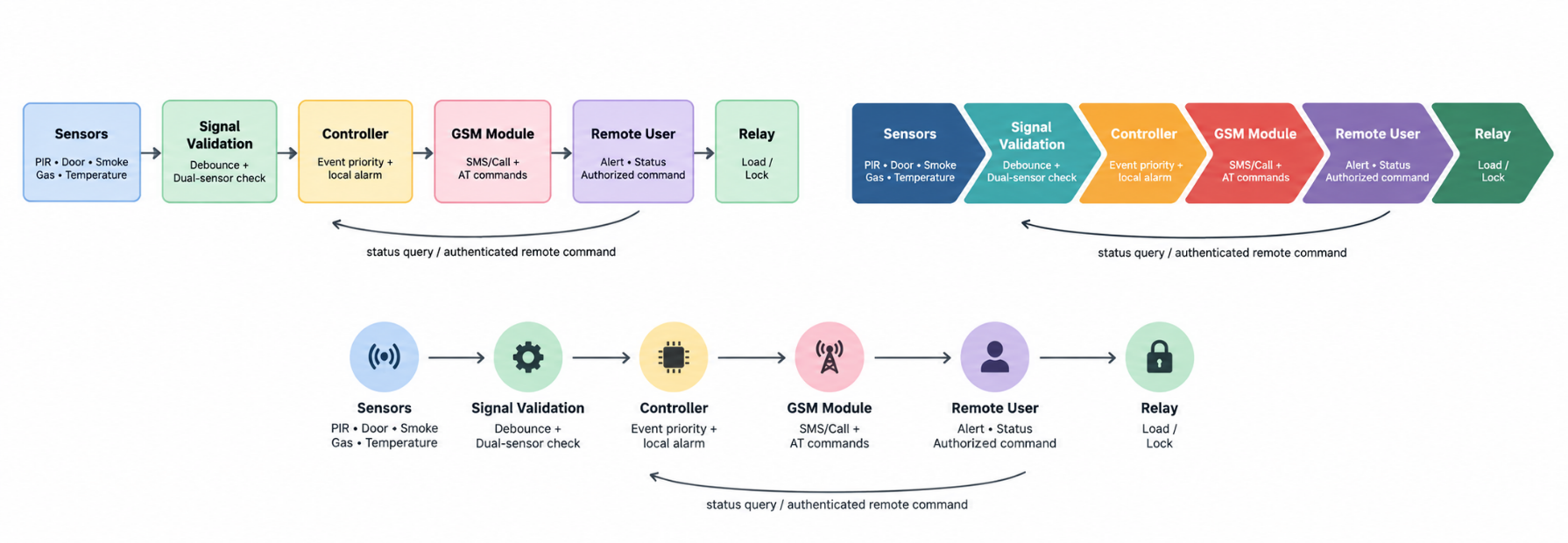
This methodology paper proposes an improved Global System for Mobile Communications (GSM)-based home security and monitoring framework intended for remote applications where continuous broadband Internet connectivity cannot be assumed. The design integrates intrusion, door-state, smoke/gas and temperature sensing with a microcontroller, local alarm unit, GSM modem and relay interface. Performance improvement is introduced through four coordinated mechanisms: sensor-event validation to suppress transient false alarms, event prioritization for safety-critical conditions, authenticated bidirectional SMS control with delivery/response checking, and power-aware standby operation. Earlier GSM home-automation studies demonstrated the practicality of mobile remote control and SMS notification, while later security-oriented systems expanded sensing and user access control (Yuksekkaya et al., 2006; Zhao & Ye, 2008; Li et al., 2015; Isa & Sklavos, 2017). The proposed methodology evaluates detection reliability, false-alarm rate, notification latency, command success rate and standby power consumption under repeatable intrusion, fire/gas and communication tests. A design-stage benchmark indicates that the improved architecture should reduce unnecessary alerts and shorten effective notification delay compared with a single-trigger GSM baseline. The paper therefore provides a reproducible development and evaluation procedure that can be implemented using low-cost embedded hardware and existing 2G GSM infrastructure, while maintaining local alarm functionality during network interruption. Numerical results in this methodology draft are explicitly illustrative and should be replaced with measured prototype data before journal submission.