Design and Implementation of GSM-Based Home Automation and Security Systems
DOI:
https://doi.org/10.65521/ijaece.v5i1.4322Keywords:
Abstract
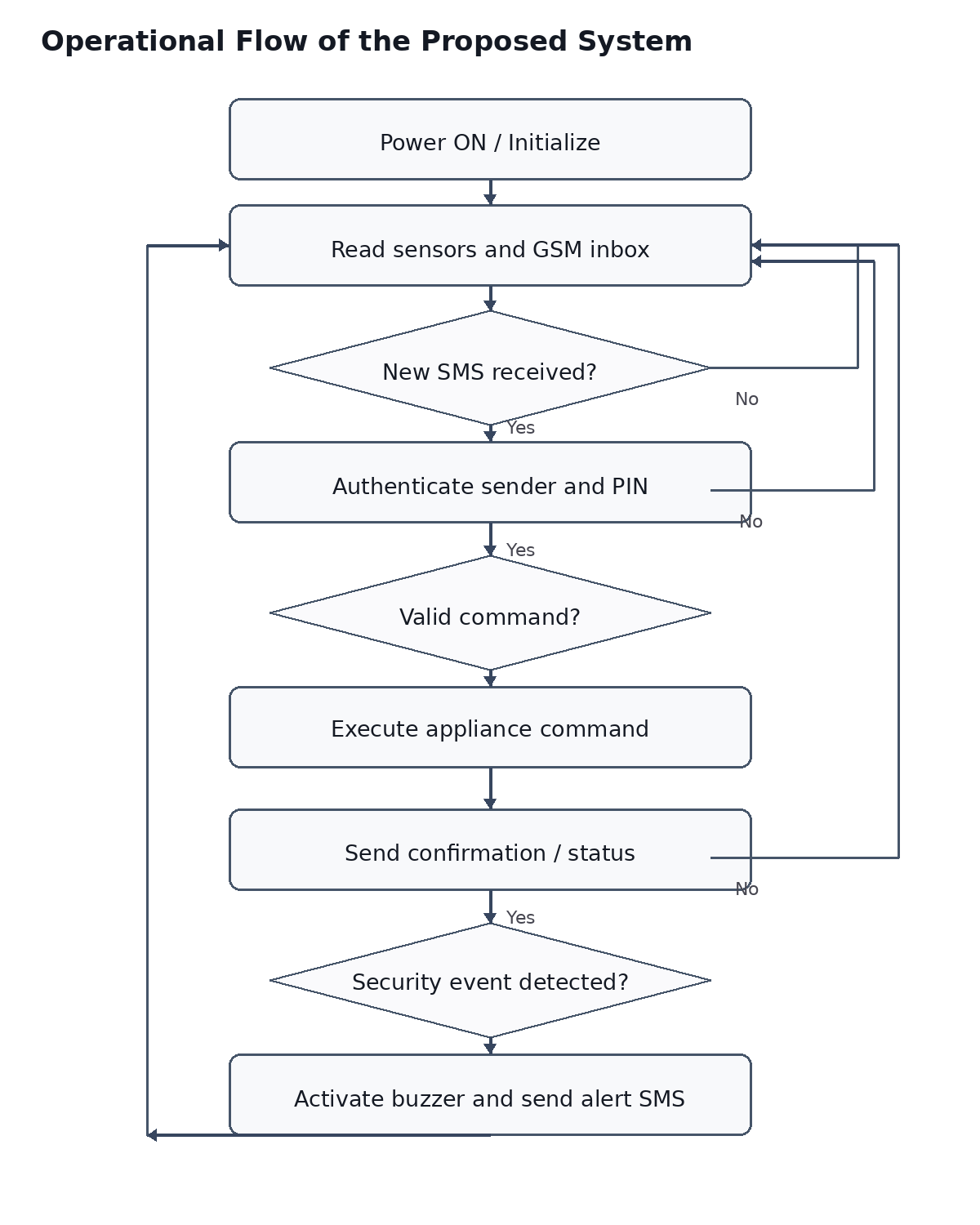
This paper presents a methodology for the design and implementation of a low-cost Global System for Mobile Communications (GSM)-based home automation and security system that permits remote appliance control and event-driven security notification through Short Message Service (SMS). The proposed architecture integrates a GSM modem, a microcontroller, relay/driver circuits, and environmental and intrusion sensors. Incoming messages are authenticated using an authorized phone-number list and a command-level personal identification number before appliance commands are accepted. The same communication path is used in reverse to report device status and to transmit alarms generated by motion, door-opening, smoke/gas, or abnormal-temperature events. The methodology emphasizes modular hardware, deterministic firmware, command acknowledgement, fail-safe relay behavior, and functional testing under normal and alarm conditions. A prototype-oriented evaluation framework is defined using command success rate, alert delivery, response latency, false-trigger resistance, and recovery after power interruption. The design draws on pre-2017 GSM and wireless home-automation research and adapts those principles into a single security-and-control platform suitable for residential applications where broadband connectivity may be unavailable or unreliable. The resulting approach is inexpensive, easy to extend, and capable of remote supervision over the geographical coverage of the cellular network.