Performance Evaluation of Multilevel Inverters for Renewable Energy Applications
DOI:
https://doi.org/10.65521/ijaece.v4i1.4317Keywords:
Abstract
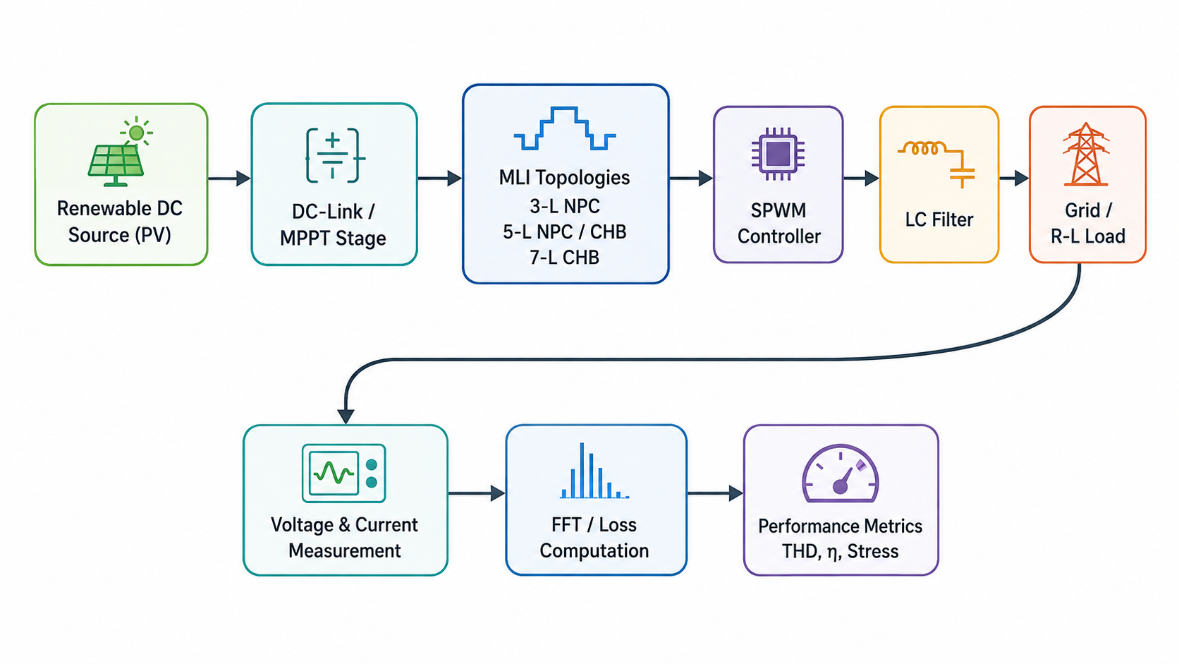
Multilevel inverters (MLIs) are attractive interfaces for photovoltaic, wind, battery and hybrid renewable-energy systems because they synthesize near-sinusoidal voltages from multiple dc levels while reducing device voltage stress and output filtering requirements. This paper presents a reproducible methodology for evaluating the performance of representative neutral-point-clamped (NPC) and cascaded H-bridge (CHB) multilevel inverter configurations under a common renewable-energy test bench. The evaluation considers a 2 kW, 230 V, 50 Hz single-phase photovoltaic-fed system and compares a three-level NPC, five-level NPC, five-level CHB and seven-level CHB inverter using sinusoidal pulse-width modulation. Total harmonic distortion (THD), conversion efficiency, switch voltage stress, output-voltage quality and implementation complexity are used as decision metrics. A model-based benchmark indicates that increasing the number of levels improves harmonic performance, while the CHB structure offers favorable modularity for separately sourced renewable dc inputs. Under the selected operating point, the seven-level CHB achieved the lowest voltage THD (2.4%), whereas the five-level CHB provided a strong compromise between efficiency, component count and harmonic quality. The study provides a compact evaluation framework suitable for selecting multilevel converter structures in renewable-energy applications without overstating hardware-level validation.