Residual-Energy and Distance-Aware Clustering for Improved Lifetime in Wireless Sensor Networks
DOI:
https://doi.org/10.65521/ijaece.v4i1.4315Keywords:
Abstract
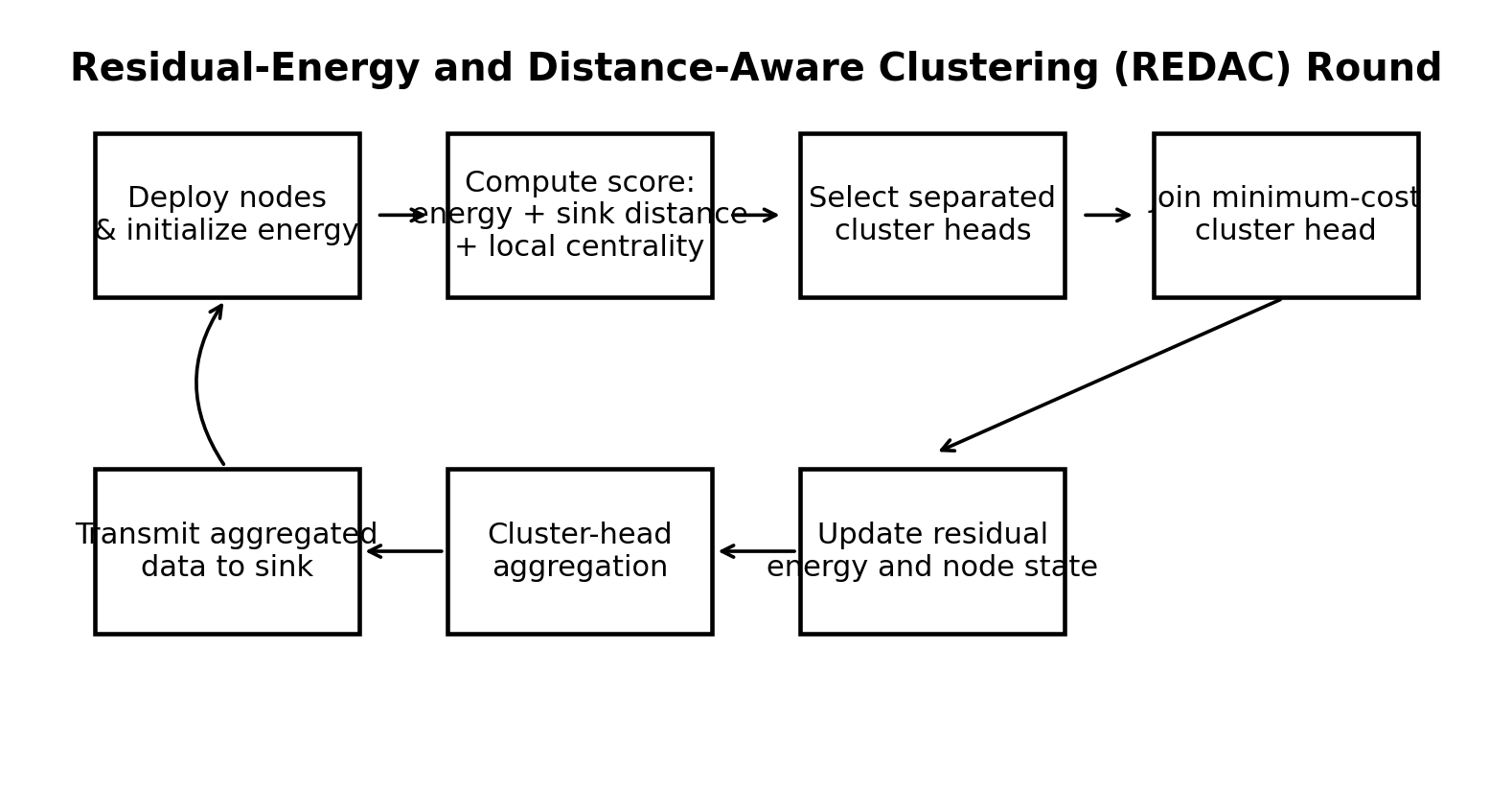
Wireless sensor networks (WSNs) operate under strict energy constraints because sensor nodes are commonly battery powered and are expected to remain unattended for long periods. Routing therefore has a direct influence on network lifetime, coverage continuity, and the reliability of sensed-data delivery. This methodology paper develops and evaluates an energy-efficient routing framework by combining residual-energy awareness, sink-distance awareness, and local node centrality in a proposed Residual-Energy and Distance-Aware Clustering (REDAC) protocol. LEACH and PEGASIS are selected as established reference protocols because they represent two influential energy-saving strategies: randomized clustering and chain-based data gathering. A controlled simulation methodology is defined using 100 static nodes in a 100 m x 100 m field, a remote base station, a first-order radio-energy model, 4000-bit data packets, and an initial energy of 0.5 J per node. Twenty independent deployments are simulated for each protocol. Performance is assessed using first-node-death (FND), half-node-death (HND), last-node-death (LND), and the alive-node trajectory. The simulation shows that REDAC extends the stable operating period relative to LEACH, while PEGASIS provides the longest overall lifetime in the tested scenario. The results demonstrate that energy-efficient WSN routing is a multi-objective problem: balancing cluster-head load improves stability, whereas minimizing long-range transmissions favors total lifetime. The paper provides a reproducible procedure suitable for comparative routing studies using literature and protocol concepts available up to 2015.