A Comprehensive Review of Deep ConVGNet: Efficient Framework for Brain Tumour Classification with Masked-attention Mask Transformer based Segmentation
Keywords:
Abstract
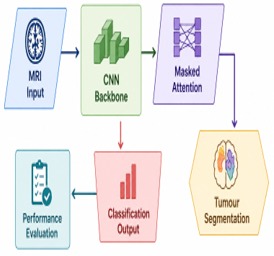
Brain tumour classification and segmentation are critical tasks in medical image analysis, essential for accurate diagnosis, treatment planning, and prognosis. Traditional machine learning approaches often struggle with the high dimensionality and heterogeneity of MRI data, while early deep learning models, though effective in classification, lack precise localization capabilities. This paper presents a comprehensive review of Deep ConVGNet, a hybrid deep learning framework designed to unify tumour classification and segmentation within a single pipeline. The architecture integrates a VGG-inspired convolutional backbone with residual connections and depth-wise separable convolutions to efficiently capture multi-scale spatial features from MRI modalities such as T1, T2, and FLAIR. For segmentation, the framework employs a Masked-Attention Mask Transformer that enhances localization accuracy by focusing attention on relevant regions, reducing computational overhead while improving boundary delineation. This combination enables precise pixel-wise segmentation alongside accurate classification. The model is evaluated on benchmark datasets including BraTS and Figshare, demonstrating strong performance across metrics such as Dice Similarity Coefficient, accuracy, and F1-score. Optimization techniques such as data augmentation, mixed-precision training, and adaptive learning schedules further improve robustness and efficiency. Overall, this review highlights the effectiveness of hybrid CNN-transformer architectures in developing accurate, efficient, and clinically deployable brain tumour analysis systems.