A Comparative Study of Cloud Computing Platforms for Enterprise Applications
DOI:
https://doi.org/10.65521/ijacte.v5i1.4605Keywords:
Abstract
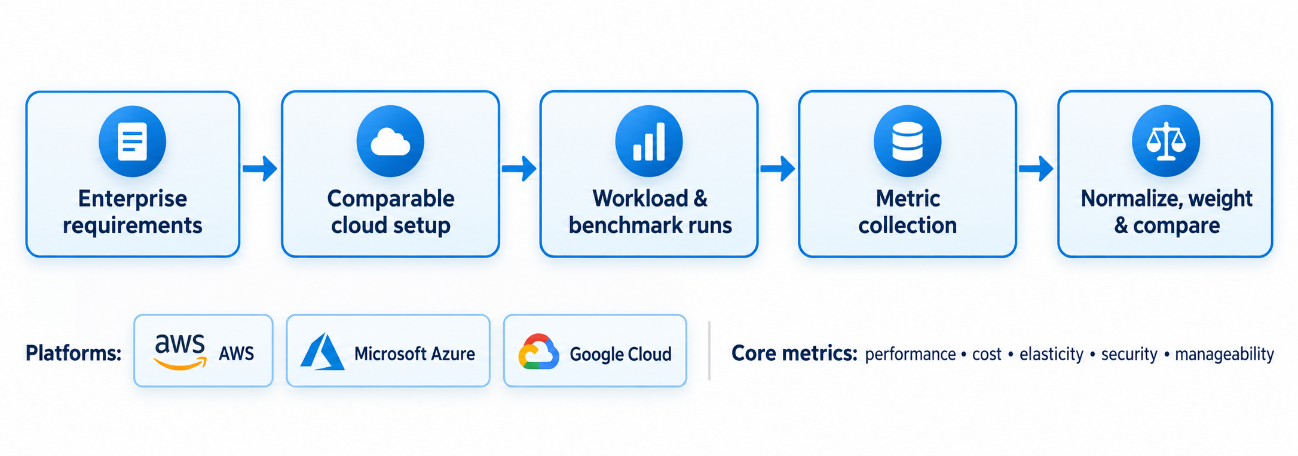
Cloud computing became a practical enterprise delivery model by combining on-demand resource provisioning, virtualization, measured usage and elastic scaling. Yet enterprise adoption is not simply a choice of the least expensive provider; platform fit depends on workload behavior, service quality, governance, security, interoperability and operational effort. This paper presents a methodology for comparing three representative public-cloud platforms—Amazon Web Services (AWS), Microsoft Azure and Google Cloud Platform (GCP)—for enterprise application deployment using evidence and evaluation concepts available up to 2016. The method defines a common application profile, deploys equivalent compute, storage and network configurations, measures repeatable technical indicators, and combines them with enterprise-oriented qualitative criteria. Metrics are normalized and analyzed through a weighted multi-criteria model rather than a single benchmark. The comparative analysis indicates that provider selection is workload- and organization-dependent: differences in elasticity, service integration, management, security assurance and cost behavior can change the preferred platform even when raw compute performance is similar. The proposed procedure therefore offers a reproducible framework for enterprise cloud selection without assuming that one provider is universally superior.\