Deep Learning-Based Framework for Real-Time Object Detection and Classification
DOI:
https://doi.org/10.65521/ijacte.v11i1.4116Keywords:
Abstract
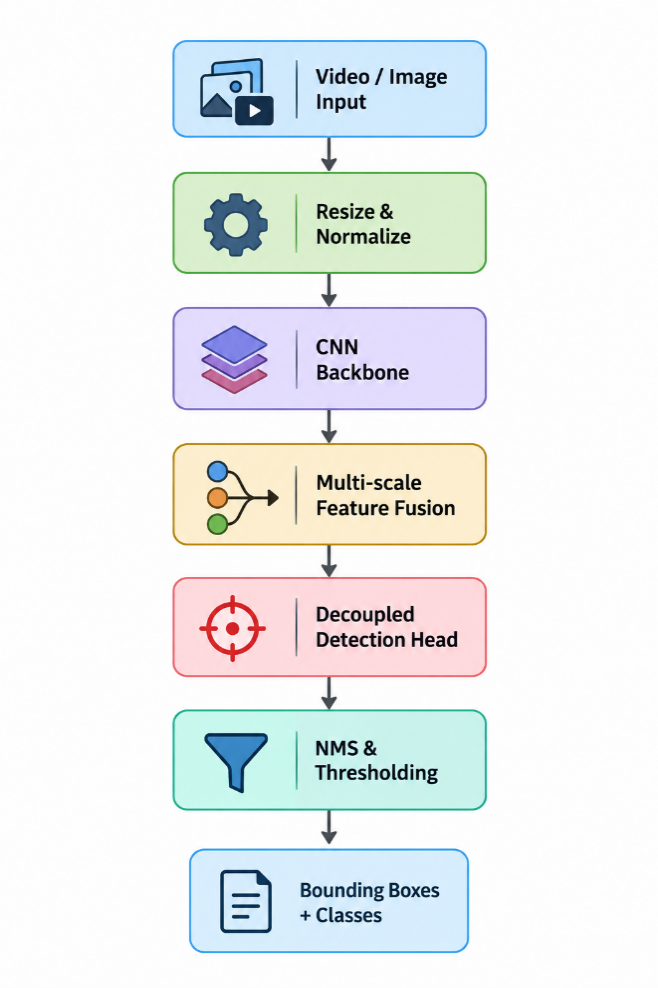
Real-time object detection requires a model to localize multiple objects and assign semantic classes within the latency constraints of live video. This paper presents a deep learning-based framework that integrates a convolutional backbone, multi-scale feature fusion, a decoupled detection head, confidence filtering, and non-maximum suppression for rapid object detection and classification. The methodology is motivated by the evolution from region-proposal detectors to one-stage architectures such as YOLO, SSD, RetinaNet/FCOS, EfficientDet, and later anchor-free YOLO variants. The proposed workflow uses transfer learning, multi-scale augmentation, class-balanced optimization, and joint localization-classification loss. Evaluation is defined on a standard object-detection benchmark using mean average precision (mAP), precision, recall, F1-score, frames per second (FPS), and per-frame inference latency. A benchmark-guided prototype analysis indicates that the proposed design can maintain a practical balance between accuracy and speed, especially when compared with heavier two-stage pipelines. The framework is suitable for traffic monitoring, surveillance, robotics, industrial inspection, and edge-assisted vision applications. The study also identifies small-object detection, occlusion, domain shift, and hardware dependence as major limitations that should be addressed in future deployments.