Artificial Intelligence Techniques for Predictive Analytics in Smart Healthcare Systems
DOI:
https://doi.org/10.65521/ijacte.v11i1.4112Keywords:
Abstract
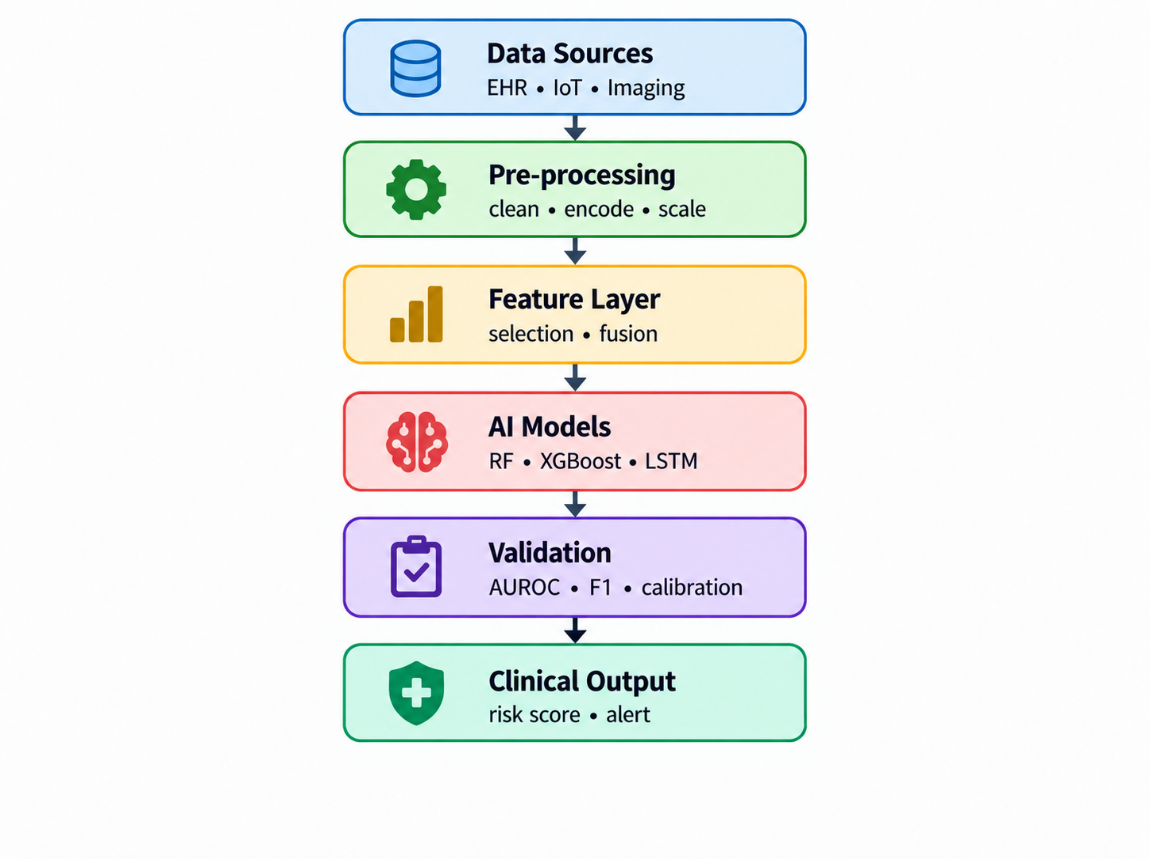
Smart healthcare systems increasingly combine electronic health records (EHRs), wearable and Internet of Things (IoT) streams, laboratory measurements, medical images, and administrative data. The volume and heterogeneity of these data create an opportunity for artificial intelligence (AI) to move healthcare from reactive treatment toward predictive and preventive decision support. This methodology paper proposes a structured AI-enabled predictive analytics framework for estimating patient-level risks such as clinical deterioration, readmission, disease progression, and complication development. The framework integrates data ingestion, quality control, feature engineering, multimodal representation, model development, calibration, explainability, privacy protection, and clinical validation. Candidate algorithms include logistic regression as a transparent baseline, random forest and gradient-boosting ensembles for structured records, and long short-term memory (LSTM) networks for longitudinal time-series data. Evaluation is based on discrimination, precision-recall behavior, calibration, sensitivity, specificity, and clinical utility rather than accuracy alone. The methodology is grounded in research published up to 2022, including large-scale EHR deep learning, multimodal fusion, federated learning, and clinical outcome prediction studies. An illustrative prototype benchmark is included only to demonstrate the planned analysis workflow; it is not presented as a real clinical trial. The proposed architecture emphasizes reproducibility, external validation, algorithmic fairness, explainability, and clinician oversight so that predictive models can support safer and more actionable smart healthcare decisions.