Artificial Intelligence Methods for Alzheimer’s Disease Recognition Using Central Lobe EEG Signals: A Survey
DOI:
https://doi.org/10.65521/ijacte.v12i2.3823Keywords:
Abstract
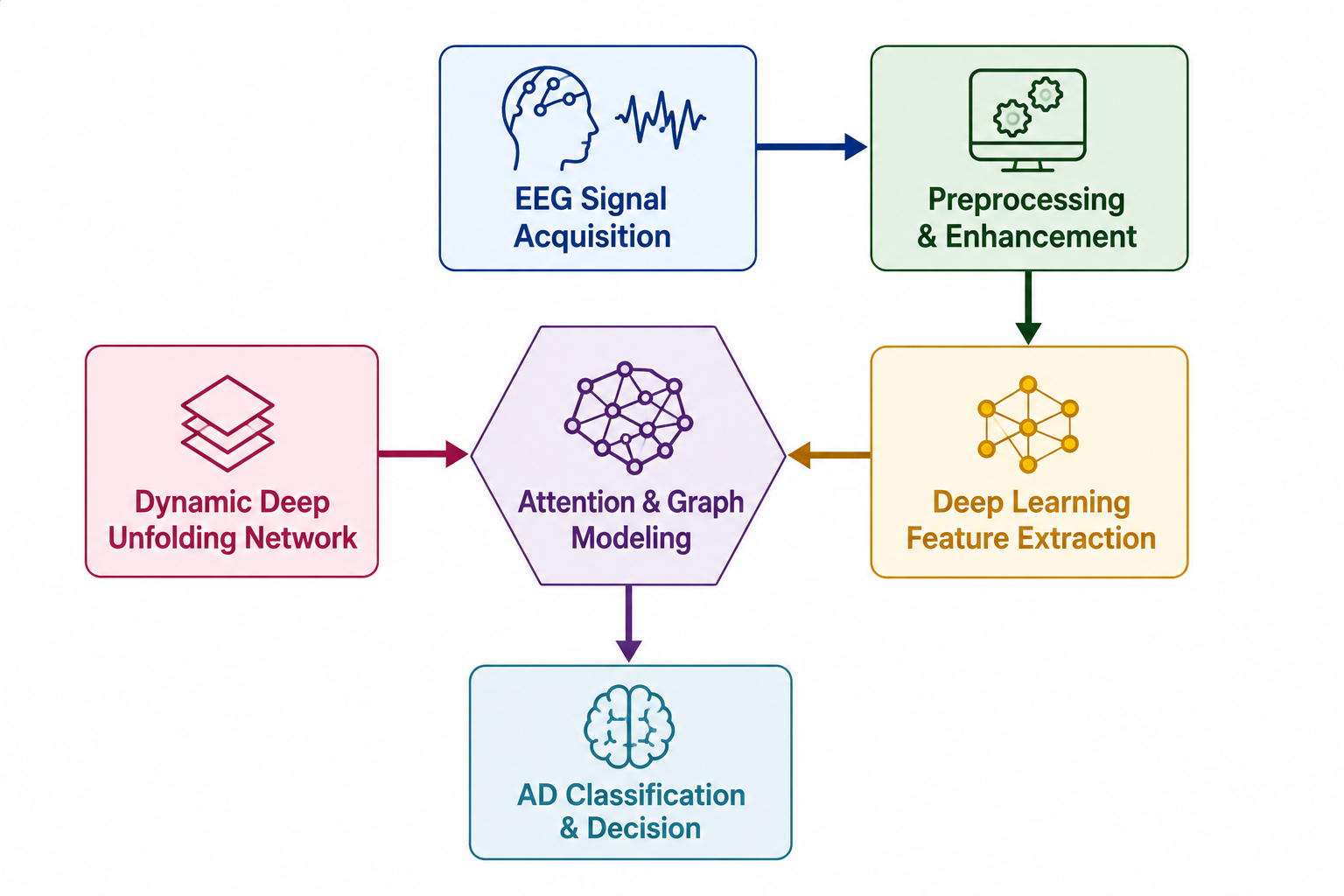
Alzheimer’s disease (AD) is a progressive neurodegenerative disorder that severely impacts memory, cognition, and daily functioning. Early and accurate detection remains a major challenge due to the limitations of traditional diagnostic approaches such as neuroimaging and clinical assessments. Electroencephalography (EEG), particularly central lobe EEG signals, provides a non-invasive and cost-effective alternative for detecting neural abnormalities associated with AD. Recent advances in Artificial Intelligence (AI), especially deep learning, have significantly improved EEG-based diagnostic systems. This survey explores recent methods and architectures for Alzheimer’s disease identification, focusing on dynamic path-controllable deep unfolding networks and residual attention neural networks. Deep learning models, such as convolutional neural networks (CNNs) and graph neural networks (GNNs), have demonstrated superior performance by automatically extracting hierarchical features from EEG signals. For instance, deep CNN-based approaches have been shown to effectively classify Alzheimer’s disease using EEG-derived spectrogram representations. Moreover, graph-based models capture functional connectivity between EEG channels, enhancing classification accuracy. Residual attention mechanisms further improve performance by emphasizing relevant brain regions and suppressing noise. Despite these advancements, challenges such as limited datasets, signal noise, and lack of interpretability persist. This survey highlights recent trends, compares existing approaches, and outlines future directions for developing efficient and clinically applicable AD diagnostic systems.