Deep Learning and Optimization Approaches in Efficient Resource Management in 6G Communication Networks Using a Hybrid Quantum Duplet-Convolutional Neural Network Model: A Review
DOI:
https://doi.org/10.65521/ijacte.v13i2.3786Keywords:
Abstract
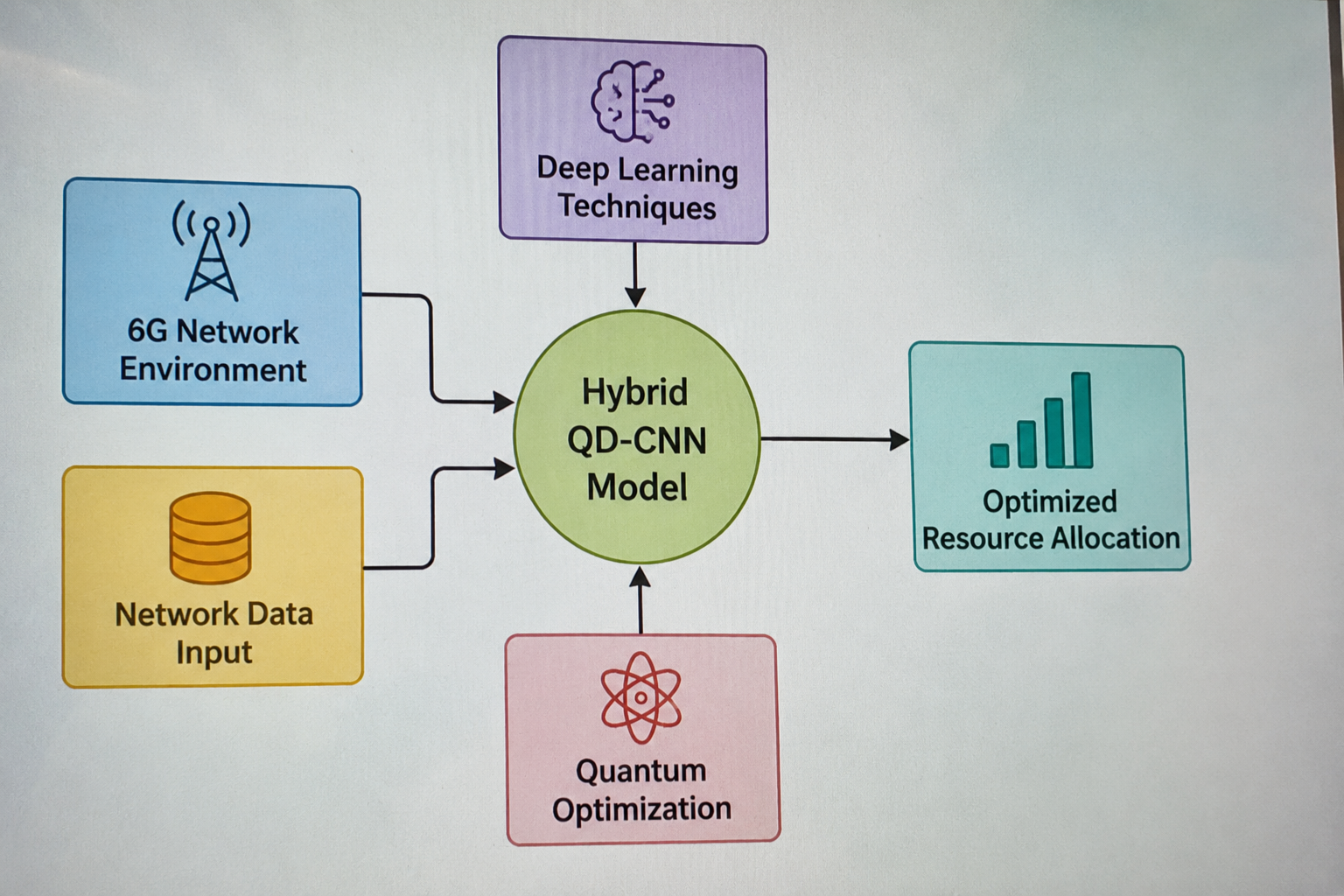
The rapid evolution of sixth-generation (6G) communication networks has introduced significant challenges in resource management due to ultra-high data rates, massive device connectivity, and stringent latency requirements. Efficient allocation of spectrum, power, bandwidth, and computing resources is essential to maintain Quality of Service (QoS), network reliability, and energy efficiency. Conventional optimization methods often struggle to adapt to the dynamic and heterogeneous nature of 6G environments, prompting the adoption of Artificial Intelligence (AI) and deep learning techniques. This review presents a comprehensive analysis of deep learning and optimization approaches for efficient resource management in 6G networks, with particular emphasis on hybrid Quantum Duplet-Convolutional Neural Network (QD-CNN) models. These architectures combine the feature extraction capability of convolutional neural networks with quantum computing principles to improve optimization efficiency and computational performance. The review examines CNN-based resource allocation, reinforcement learning for dynamic scheduling, and quantum machine learning for complex optimization tasks, including network slicing, beamforming, and load balancing. It also discusses emerging trends such as AI-driven network automation, edge intelligence, and quantum-assisted optimization. Despite promising advancements, challenges including computational complexity, limited training data, security concerns, and practical implementation remain significant. Overall, hybrid QD-CNN models represent a promising direction for achieving scalable, intelligent, and efficient resource management in future 6G communication networks.