A Survey of EEG-Based Schizophrenia Identification Using Dynamic Functional Connectivity and Stack-Augmented Conditional Variational Autoencoders
DOI:
https://doi.org/10.65521/ijacte.v13i1.3777Keywords:
Abstract
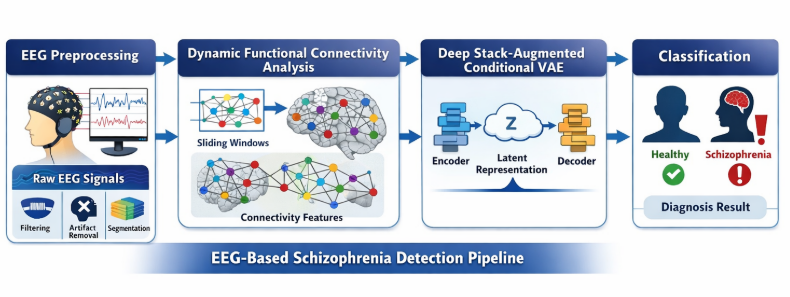
Schizophrenia is a severe neuropsychiatric disorder characterized by disturbances in perception, cognition, and emotional regulation. Early and accurate diagnosis remains a significant challenge due to the subjective nature of clinical assessments. Electroencephalography (EEG) has emerged as a promising non-invasive tool for identifying neural abnormalities associated with schizophrenia. In recent years, artificial intelligence and deep learning techniques have significantly enhanced the capability of EEG-based diagnostic systems. This survey presents a comprehensive analysis of methods and architectures developed for automatic schizophrenia identification using EEG signals, with a particular focus on dynamic functional connectivity (DFC) analysis and deep stack-augmented conditional variational autoencoder (DSA-CVAE) frameworks. The paper explores how temporal brain connectivity patterns can be effectively captured and modeled to improve classification accuracy. Furthermore, it examines the integration of generative models for robust feature extraction and latent representation learning. The survey highlights key advancements, methodological trends, datasets, and performance metrics reported in the literature. Challenges such as data variability, noise sensitivity, and model generalization are also discussed. Finally, future research directions are proposed to guide the development of more reliable and clinically applicable diagnostic systems.