Hybrid Signal Processing and Deep Feature Learning for ECG-Driven Atrial Fibrillation Diagnosis
DOI:
https://doi.org/10.65521/ijacte.v15i2.3299Keywords:
Abstract
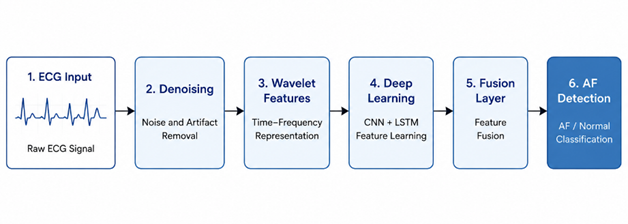
Atrial Fibrillation (AF) is a life-threatening cardiac arrhythmia that requires accurate and early detection for effective clinical intervention. Electrocardiogram (ECG)-based automated diagnosis has gained significant attention, particularly with the advancement of wearable and remote health monitoring systems. However, ECG signals are inherently noisy and exhibit complex nonlinear patterns, making reliable AF detection a challenging task. This study proposes a Hybrid Signal Processing and Deep Feature Learning framework for ECG-driven Atrial Fibrillation diagnosis. The proposed model integrates advanced signal processing techniques such as bandpass filtering, wavelet denoising, and spectral decomposition with deep feature learning architectures including Convolutional Neural Networks (CNN) and Long Short-Term Memory (LSTM) networks. The signal processing module enhances signal quality by removing artifacts and extracting frequency-domain characteristics, while the deep learning module automatically learns discriminative spatial-temporal features from processed ECG signals. The hybrid architecture is evaluated using standard ECG datasets, and performance is measured using accuracy, sensitivity, specificity, precision, and F1-score. Experimental results demonstrate that the proposed hybrid framework significantly outperforms traditional machine learning models and standalone deep learning approaches by effectively capturing both signal-level and feature-level representations of ECG data. The proposed system is well-suited for real-time clinical decision support systems and wearable cardiac monitoring devices, enabling efficient and scalable atrial fibrillation detection in practical healthcare environments.