
A Deep Learning Approach for Detecting Pesticide Residues on Brinjal
DOI:
https://doi.org/10.65521/ijacte.v15i1S.1300Keywords:
Abstract
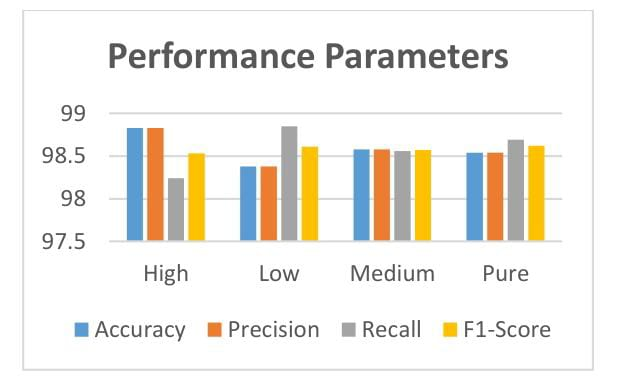
Pesticide residue classification is an essential task that involves finding and classifying pesticide levels built on hyperspectral image data. This process is extensively used in the field of agricultural quality review and food security monitoring. The proposed system covers three key phases, preparation of data, feature extraction, and classification. A modified deep learning neural network architecture, HSI-SpaClassNet, is used to categorize pesticide remains on Brinjal. To attain precise classification, the proposed system uses spatial features extracted from hyperspectral images as inputs to the model. Proposed approach provides better performance as compared to existing models such as MobileNet, EfficientNet, and DenseNet on the Brinjal dataset. Proposed model gives accuracy 98.58% while others deep learning models gives accuracy 97.25% for MobileNet, 96.15% for EfficientNetB0 and 91.86% for DenseNet Model. This paper presents a detailed comparison between the proposed architecture and existing algorithms highlighting the model’s effectiveness for rapid and precise pesticide residue detection.
Downloads
Published
How to Cite
Issue
Section
License

This work is licensed under a Creative Commons Attribution-NoDerivatives 4.0 International License.
