Synthesis and Characterization of Metal Oxide Nanoparticles for Wastewater Treatment Applications
DOI:
https://doi.org/10.65521/ijacsa.v7i1.4368Keywords:
Abstract
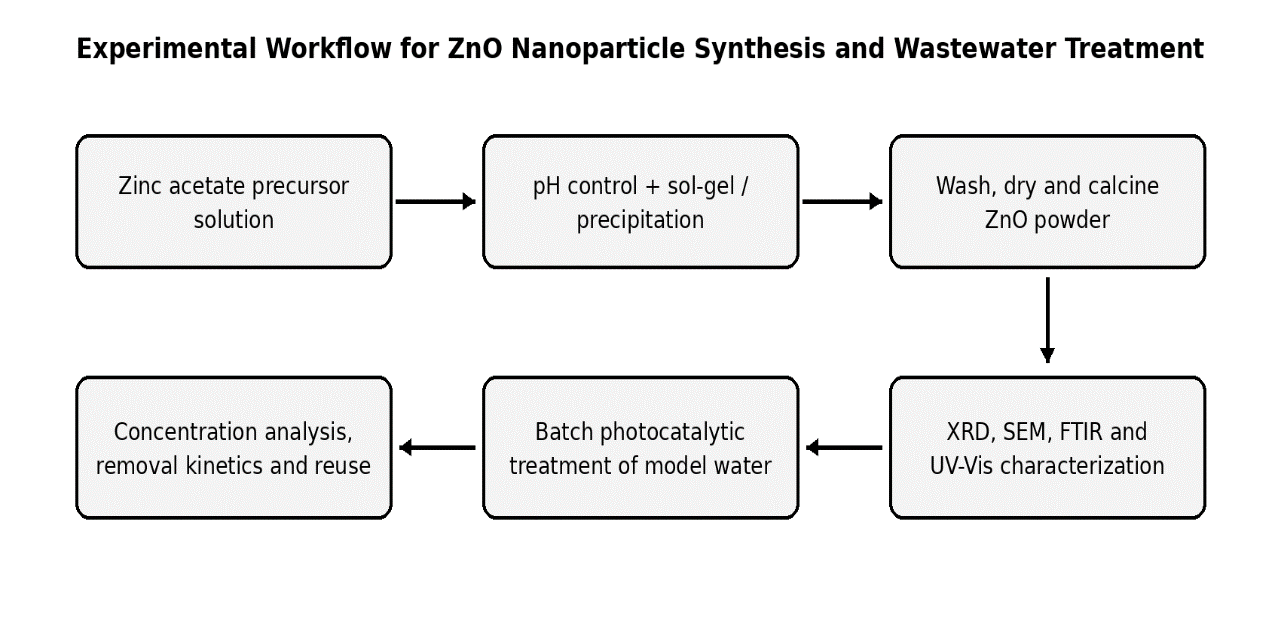
Metal oxide nanoparticles are attractive materials for water and wastewater remediation because their nanoscale dimensions provide high surface area, tunable optical properties, catalytic activity and, in some systems, magnetic recoverability. This methodology paper develops a reproducible laboratory procedure for the synthesis, characterization and treatment evaluation of zinc oxide (ZnO) nanoparticles as a representative metal oxide photocatalyst. The proposed route uses a wet-chemical sol-gel/precipitation method followed by drying and calcination, after which the material is characterized by X-ray diffraction (XRD), scanning electron microscopy (SEM), Fourier-transform infrared spectroscopy (FTIR) and UV-Visible spectroscopy. Wastewater-treatment performance is evaluated with a model dye solution under controlled irradiation, catalyst dosage, pH and contact time. Removal efficiency and pseudo-first-order kinetic constants are calculated from UV-Visible concentration measurements, while catalyst recovery and reusability are assessed through repeated treatment cycles. The method is grounded entirely in literature available through 2018. Pre-2019 studies show that ZnO, TiO2 and iron-oxide nanomaterials can remove dyes, heavy metals and other pollutants through photocatalysis and adsorption [1-6]. The paper therefore provides a compact experimental framework suitable for laboratory validation, comparison of synthesis conditions and subsequent optimization for real wastewater. The results section reports literature-supported performance targets rather than claiming unperformed original measurements.