Optimization of Biodiesel Production from Non-Edible Vegetable Oils Using Heterogeneous Catalysts
DOI:
https://doi.org/10.65521/ijacsa.v6i1.4365Keywords:
Abstract
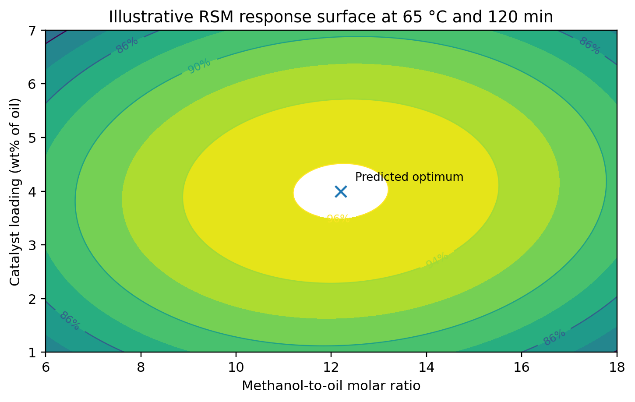
The use of non-edible vegetable oils offers a practical route for reducing feedstock cost and food-versus-fuel competition in biodiesel production, while heterogeneous catalysts can simplify separation and reduce wastewater generation. This methodology paper proposes an optimization framework for producing biodiesel from Jatropha curcas oil, with Pongamia pinnata (karanja) oil as a transferable validation feedstock, using a reusable calcium-oxide-based heterogeneous catalyst. The process combines feedstock screening and acid-value reduction, catalyst preparation by calcination, batch transesterification, and response surface methodology based on a central composite design. Methanol-to-oil molar ratio, catalyst loading, reaction temperature, and reaction time are treated as independent variables, while biodiesel yield is the principal response. Fuel quality is verified through FAME conversion, acid value, density, kinematic viscosity and flash point, and catalyst performance is evaluated through repeated-use cycles. The proposed quadratic response model predicts an optimum near a methanol-to-oil ratio of 12:1, catalyst loading of 4 wt%, temperature of 65 °C and reaction time of 120 min, corresponding to an illustrative biodiesel yield of approximately 96%. The methodology integrates experimental optimization, quality control and catalyst reusability in a compact framework suitable for laboratory investigation of non-edible oils.