Adsorptive Removal of Heavy Metal Ions from Industrial Wastewater Using Activated Carbon
DOI:
https://doi.org/10.65521/ijacsa.v6i1.4364Keywords:
Abstract
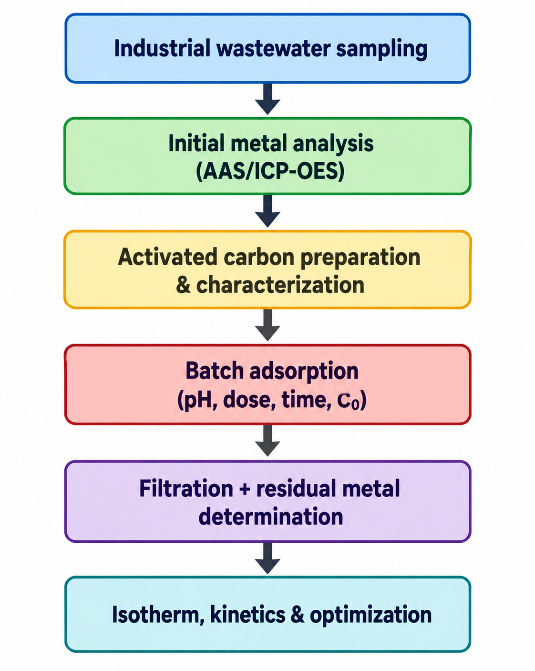
Heavy-metal contamination of industrial wastewater is persistent because metallic ions are non-biodegradable and may accumulate in aquatic and biological systems. This methodology paper presents a reproducible batch-adsorption framework for removing Pb(II), Cd(II), Cu(II), and Ni(II) from industrial wastewater using activated carbon. The approach combines wastewater characterization, adsorbent preparation and physicochemical characterization, controlled adsorption experiments, residual metal analysis, and mathematical interpretation using removal efficiency, adsorption capacity, kinetic models, and Langmuir and Freundlich isotherms. Experimental variables are pH, contact time, activated-carbon dosage, and initial metal concentration. Metal concentrations are quantified by atomic absorption spectrophotometry (AAS) or inductively coupled plasma optical emission spectrometry (ICP-OES). Literature shows that activated carbons made from agricultural, municipal, and tyre-derived precursors can provide high metal uptake because of their porous structure and oxygen-containing surface groups. For demonstration, an illustrative data set shows removal efficiency of 94% Pb(II), 85% Cd(II), 90% Cu(II), and 80% Ni(II) at selected optimum conditions. These numerical values are included to demonstrate analysis and should be replaced by actual laboratory measurements in an experimental submission. The proposed protocol offers a low-cost and scalable basis for evaluating activated carbon as a polishing step for metal-bearing industrial effluents.