Synthesis and Characterization of Zinc Oxide Nanoparticles by Chemical Precipitation Method
DOI:
https://doi.org/10.65521/ijacsa.v5i1.4357Keywords:
Abstract
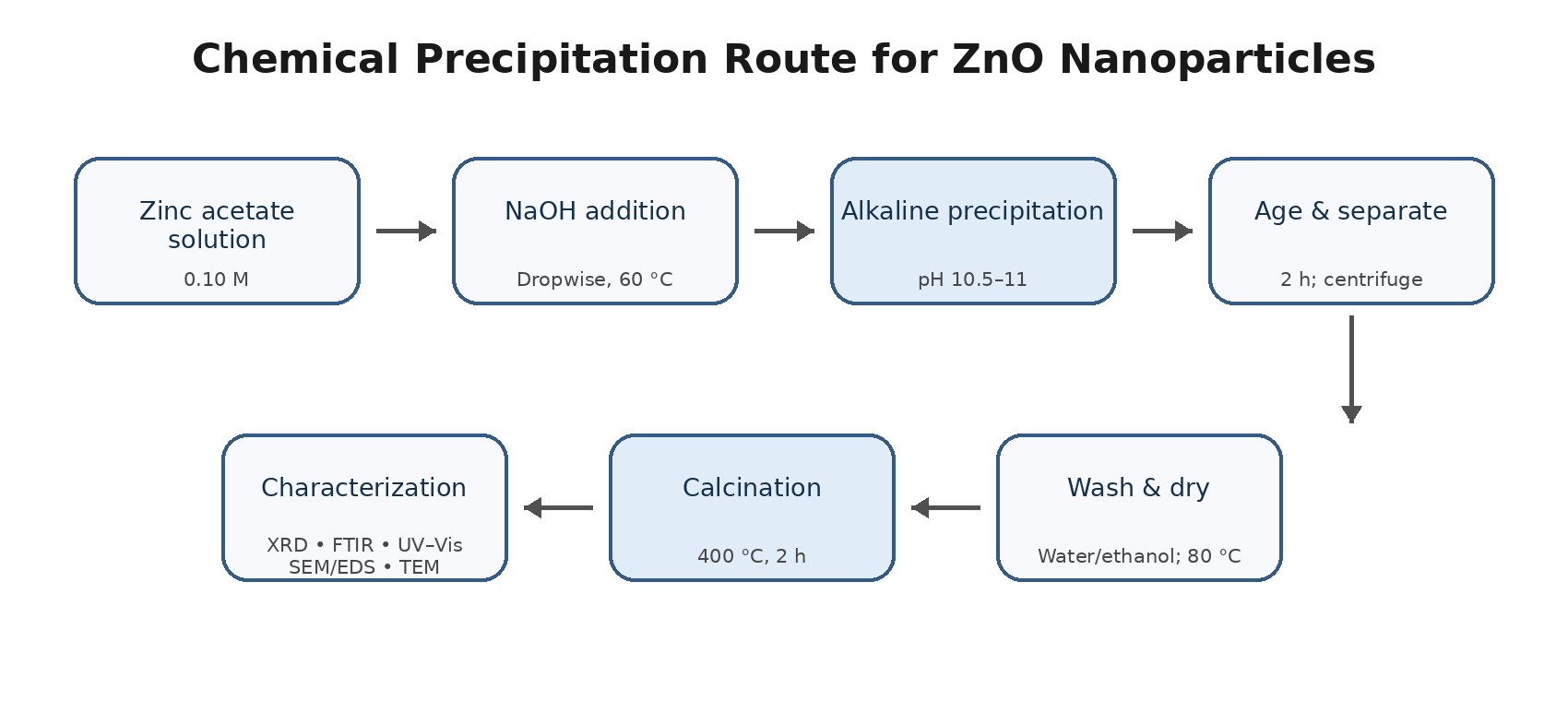
Zinc oxide (ZnO) nanoparticles are attractive functional materials because their wide direct band gap, high exciton binding energy, chemical stability, and surface activity support applications in optoelectronics, sensing, photocatalysis, antimicrobial systems, and protective coatings. This methodology paper presents a reproducible chemical precipitation route for the synthesis and characterization of ZnO nanoparticles using zinc acetate dihydrate as the zinc precursor and sodium hydroxide as the precipitating agent. The proposed procedure controls precursor concentration, pH, addition rate, stirring temperature, aging, washing, drying, and calcination so that phase purity and particle size can be assessed systematically. Structural properties are determined by X-ray diffraction (XRD) and crystallite size is estimated using the Scherrer relation. Fourier-transform infrared spectroscopy (FTIR) is used to confirm Zn–O bonding and residual surface groups; UV–visible spectroscopy is used to obtain the absorption edge and optical band gap; and scanning electron microscopy with energy-dispersive X-ray spectroscopy (SEM/EDS), with optional transmission electron microscopy (TEM), is used to evaluate morphology, agglomeration, and elemental composition. The expected outcome is single-phase hexagonal wurtzite ZnO with nanometric crystallite size and a strong ultraviolet absorption edge. An illustrative validation dataset is included to demonstrate data treatment and interpretation without representing unperformed laboratory measurements. The workflow is designed for low-cost laboratory implementation and can be adapted for studies examining pH, calcination temperature, precursor concentration, or surface modification.