Comparative Study of Physicochemical Parameters of Surface Water and Groundwater Samples
DOI:
https://doi.org/10.65521/ijacsa.v4i1.4309Keywords:
Abstract
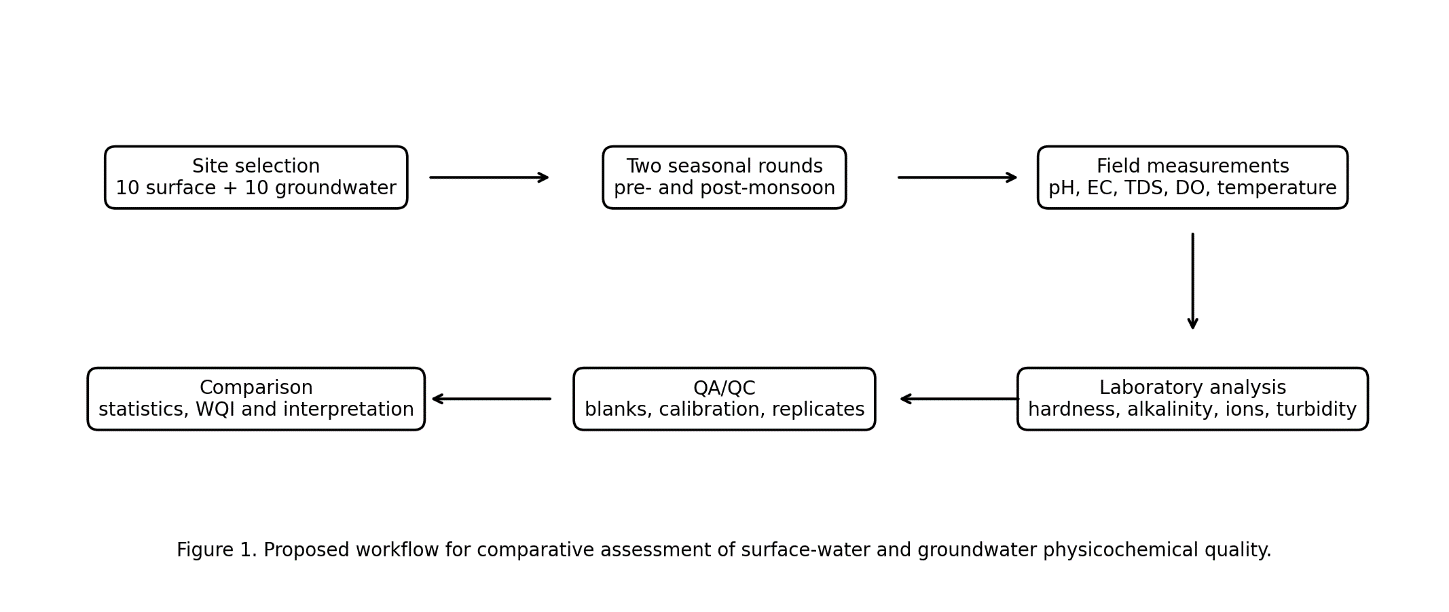
This methodology paper presents a comparative framework for evaluating physicochemical differences between surface water and groundwater. A balanced design of ten surface-water locations and ten groundwater locations, sampled during pre-monsoon and post-monsoon periods, is proposed. Field measurements include temperature, pH, electrical conductivity (EC), total dissolved solids (TDS) and dissolved oxygen (DO), while laboratory analyses include turbidity, alkalinity, total hardness, calcium, magnesium, chloride, sulphate, nitrate and fluoride. Descriptive statistics, source-wise comparison, correlation analysis and a weighted water quality index (WQI) are used to interpret overall quality. Literature available up to 2015 shows that surface water is commonly more responsive to runoff and direct anthropogenic loading, whereas groundwater chemistry is strongly influenced by mineral-water interaction, residence time and local contamination pathways. The proposed procedure integrates standardized sampling, laboratory quality control and statistical interpretation to produce a reproducible comparison suitable for academic and environmental monitoring studies. Since no primary laboratory dataset was supplied, the numerical values in the Results section are explicitly presented as an illustrative methodology-validation dataset rather than measured field results