Energy-Efficient Routing Protocol for Wireless Sensor Networks in Smart Environments
Keywords:
Abstract
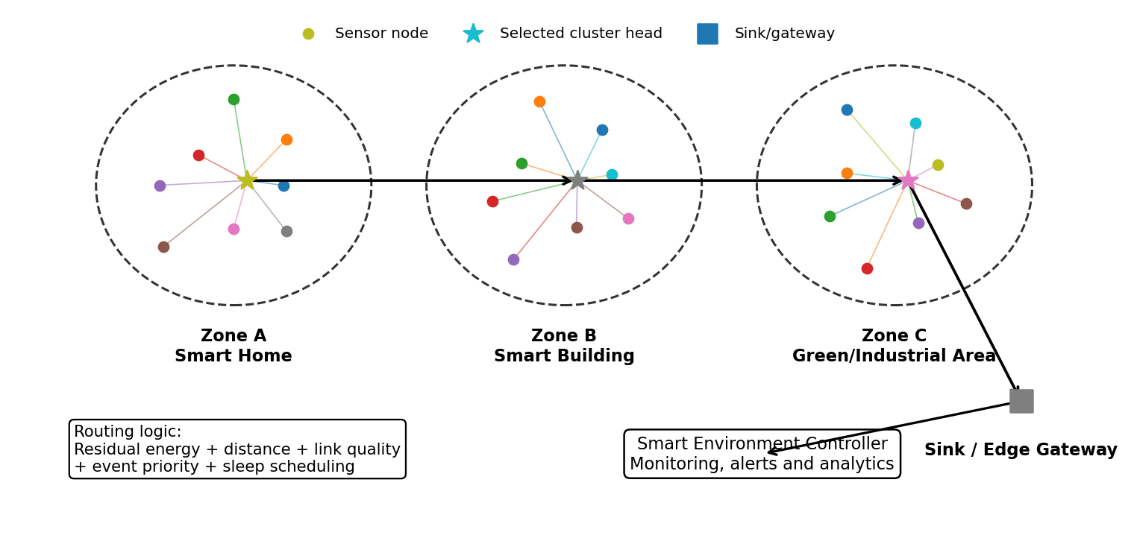
Wireless sensor networks (WSNs) are a core communication layer for smart homes, smart buildings, environmental monitoring, industrial automation and other context-aware systems, but their practical lifetime is constrained by the limited battery energy of sensor nodes. This methodology paper presents a structured approach for designing and evaluating an energy-efficient routing protocol for WSNs deployed in smart environments. The proposed Smart Environment Energy-Efficient Routing (SEER) framework combines residual-energy-aware cluster-head selection, distance-aware multi-hop forwarding, link-quality assessment, event-priority handling and node sleep scheduling. The methodology adopts the first-order radio-energy model and evaluates the protocol against established hierarchical approaches using network lifetime, first-node-death, half-node-death, residual energy, packet delivery ratio, throughput and end-to-end delay. A reproducible simulation design with controlled network size, radio parameters, traffic patterns and smart-environment events is specified. An illustrative results section demonstrates how the protocol would be analyzed without presenting simulated values as real field measurements. The expected contribution is a routing methodology that balances energy consumption across nodes while preserving responsiveness to high-priority events, making the design suitable for long-lived smart-environment sensing applications.