Performance Analysis of 5G Communication Networks for Smart City Applications
Keywords:
Abstract
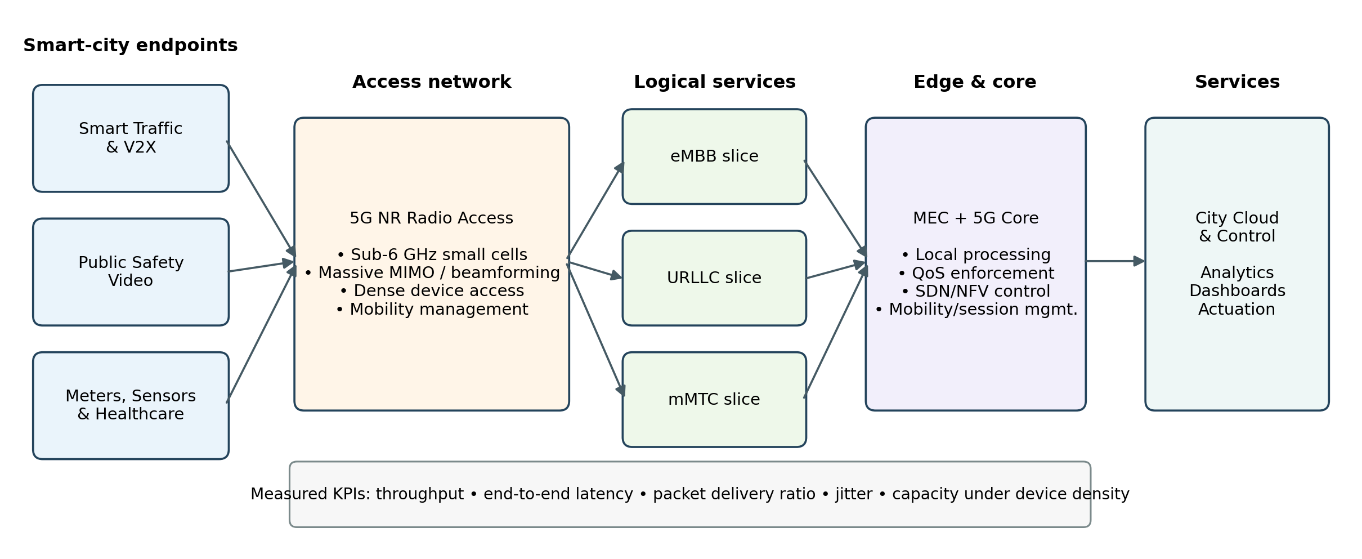
Fifth-generation (5G) communication is a key enabling technology for smart cities because it combines enhanced mobile broadband (eMBB), ultra-reliable low-latency communication (URLLC), and massive machine-type communication (mMTC) within a common network. This methodology paper develops a compact framework for evaluating 5G network performance in a heterogeneous urban environment that includes intelligent transportation, public-safety video, smart metering, environmental sensing, and connected healthcare. The proposed method evaluates network behavior under increasing endpoint density using throughput, end-to-end latency, packet delivery ratio, jitter, and service capacity as the principal key performance indicators. A parameterized analytical simulation is used to compare a 5G New Radio (NR) deployment with an LTE-class baseline while explicitly separating eMBB, URLLC, and mMTC traffic through logical service classes. The model-based results indicate that 5G maintains substantially lower latency and higher delivered traffic at high device density, while the performance margin narrows as radio and edge resources approach saturation. The study therefore emphasizes that 5G performance in smart cities depends not only on radio bandwidth, but also on small-cell density, multi-antenna transmission, edge processing, traffic prioritization, and network slicing. The framework is intended as a reproducible methodology for later validation with ns-3/5G-LENA, commercial network traces, or an operator testbed.