Performance Enhancement of 5G Wireless Communication Networks Using Advanced Spectrum Allocation Methods
Keywords:
Abstract
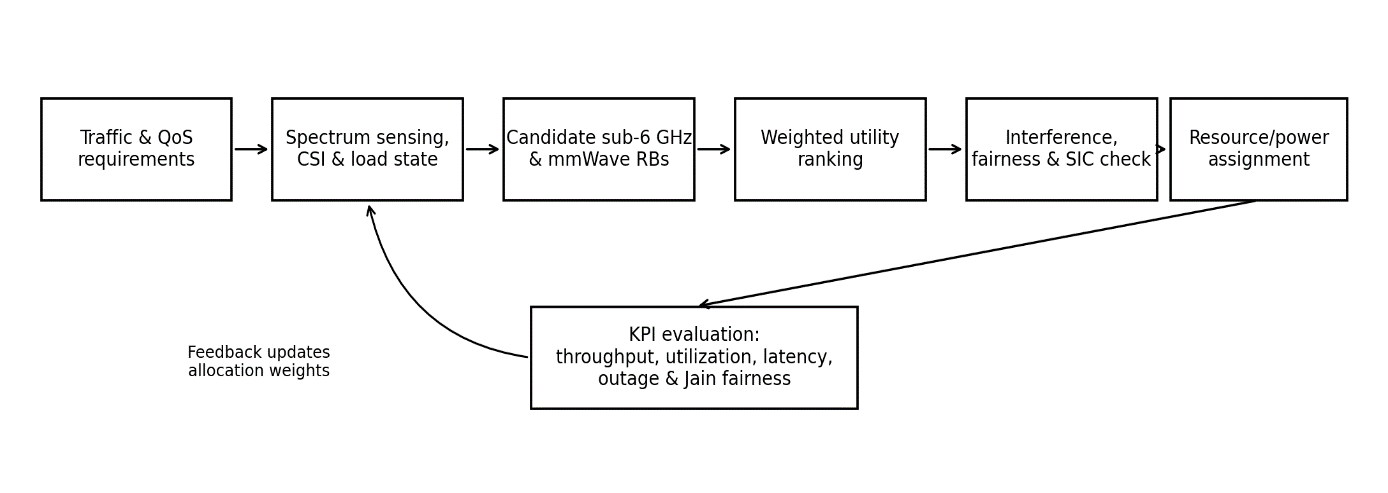
Fifth-generation wireless systems require substantially higher capacity, lower latency, and more efficient use of scarce radio spectrum than earlier cellular generations. This paper presents a methodology for evaluating performance enhancement in 5G wireless communication networks through advanced spectrum allocation. The proposed evaluation framework combines dynamic spectrum access, multi-band selection, interference-aware scheduling, QoS prioritization, and optional non-orthogonal user pairing. A heterogeneous 5G scenario containing a sub-6 GHz carrier and a millimeter-wave carrier is modeled, and three allocation strategies are compared: static allocation, greedy dynamic spectrum allocation, and an adaptive QoS-aware allocation method. The adaptive method ranks candidate resource blocks using normalized channel quality, traffic priority, cell load, expected interference, and handover cost, while preserving minimum service constraints and fairness. Simulation-oriented performance measures include aggregate throughput, spectrum utilization, mean packet latency, outage probability, and Jain's fairness index. Illustrative results generated from the stated evaluation model indicate that the adaptive method can maintain higher throughput and resource utilization as user load increases while reducing congestion-related delay and outage. The methodology is designed to be reproducible and can be implemented in MATLAB, Python, or a system-level cellular simulator. The study is grounded exclusively in research published up to 2017.