Performance Evaluation of MIMO Techniques for Next-Generation Wireless Networks
Keywords:
Abstract
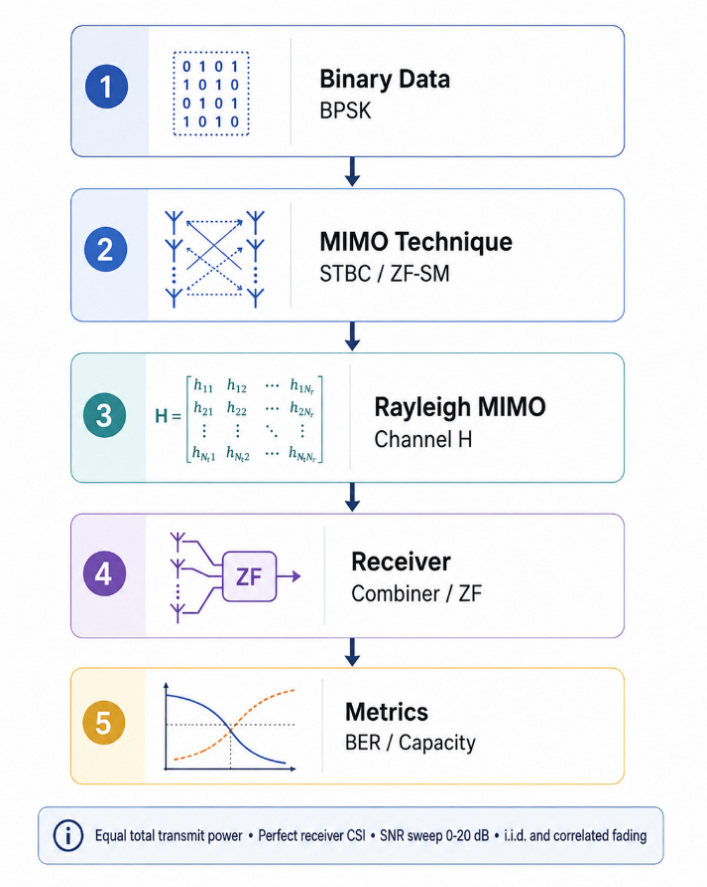
Multiple-input multiple-output (MIMO) transmission is a central mechanism for increasing spectral efficiency, link reliability, and energy efficiency without requiring a proportional increase in bandwidth. This methodology paper develops a reproducible simulation framework for evaluating representative MIMO techniques relevant to the evolution from conventional cellular links toward next-generation wireless networks. The study compares transmit diversity using the Alamouti space-time block code, spatial multiplexing using a 2×2 zero-forcing detector, and antenna-array scaling through 1×1, 2×2, and 4×4 capacity analysis. A flat Rayleigh fading model is used with equal total transmit power, receiver-side channel state information, binary phase-shift keying for error-rate experiments, and Monte Carlo averaging over independent channel realizations. A correlated 4×4 channel is also included to quantify the loss caused by spatial correlation. Performance is assessed using bit-error rate (BER) and ergodic spectral efficiency. The simulated results show that diversity coding strongly reduces BER, while spatial multiplexing and larger antenna dimensions yield substantial capacity growth. At 10 dB, the simulated ergodic capacity rises from 2.90-bit/s/Hz for SISO to 10.93-bit/s/Hz for i.i.d. 4×4 MIMO; correlation coefficient 0.7 reduces the latter to 8.31-bit/s/Hz. The framework therefore illustrates the reliability-throughput trade-off that guides MIMO selection in future wireless systems.