Recent Advances in Deep ConVGNet: Efficient Framework for Brain Tumour Classification with Masked-attention Mask Transformer based Segmentation: A Systematic Review
Keywords:
Abstract
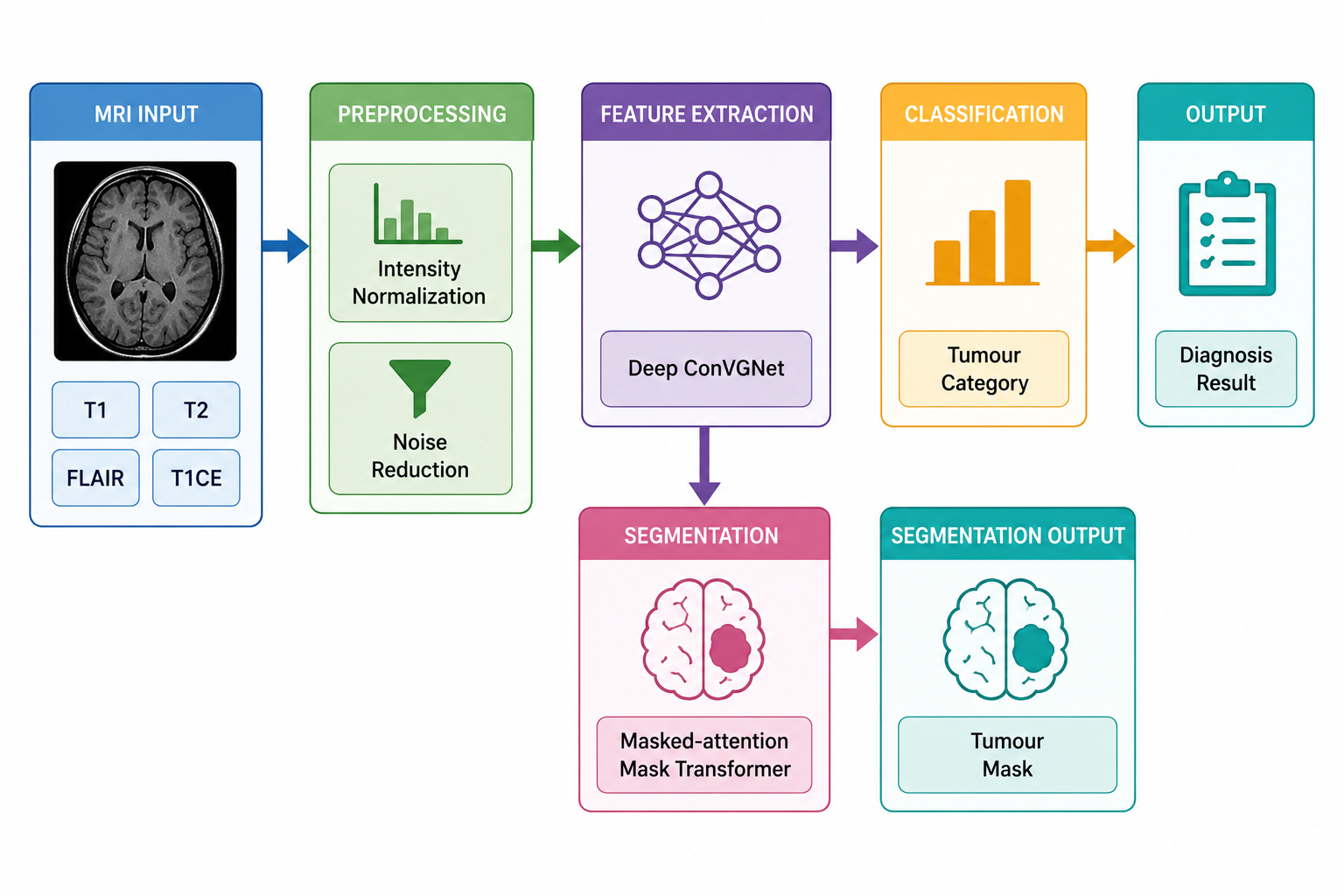
Brain tumour diagnosis is a critical and challenging task in medical imaging, requiring accurate classification and precise segmentation for effective treatment planning. Traditional diagnostic approaches rely on manual interpretation of MRI scans, which is time-consuming and prone to variability. The advancement of deep learning has enabled the development of automated systems that improve diagnostic accuracy and efficiency. This systematic review focuses on Deep ConVGNet, an advanced hybrid framework designed for brain tumour classification and segmentation. The architecture integrates a VGG-inspired convolutional network with dual-depth feature extraction, enabling effective capture of both fine-grained and high-level spatial features. This enhances classification performance across tumour types such as glioma, meningioma, and pituitary tumours. For segmentation, the framework incorporates a Masked-Attention Mask Transformer that performs precise pixel-wise tumour delineation by focusing attention on relevant regions, improving accuracy while reducing computational complexity. The model is evaluated on benchmark datasets such as BraTS and Kaggle Brain MRI, achieving high performance in terms of Dice Similarity Coefficient and classification accuracy. Optimization techniques including data augmentation, mixed precision training, and advanced learning schedules further enhance robustness.This review highlights the effectiveness of hybrid CNN-transformer models and outlines future directions for developing reliable, scalable, and clinically applicable brain tumour analysis systems.