Deep Learning Assisted Lung Cancer Screening for Early Detection
Keywords:
Abstract
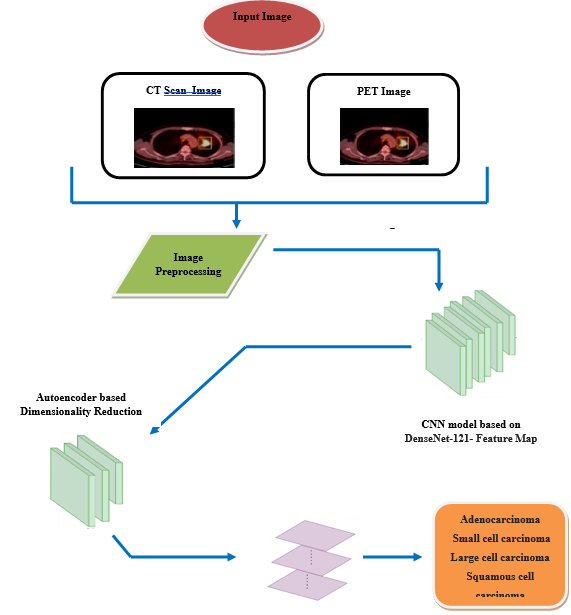
The leading cause of the greatest cancer-related death rate worldwide is lung cancer (LC). The only way to improve a patient's chances of survival is to detect lung cancer early. Nevertheless, the current LC detection models require a significant amount of processing power. The complexity of the model's execution presents difficulties for healthcare facilities. So, to detect and diagnose LC, deep learning (DL)-based medical image analysis is proposed. It uses computed tomography (CT) and positron emission tomography (PET) images to detect early indications of LC. To get rid of the noise and artifacts, efficient picture preprocessing and method was used. The DenseNet-121 model was used to create a Convolutional Neural Network (CNN) model for feature extraction. Deep autoencoders were used to reduce the dimensionality of the features. The features were utilized to determine the different types of LC using the Swin Transformer, a deep learning classifier. Performance was assessed using the Lung-PET-CT-Dx dataset. The experimental results demonstrated that, with fewer parameters, the suggested model achieved an accuracy of 98.6. The suggested methodology can be used in real time to help doctors and radiologists identify LC early on.